Saturday, August 10, 2024

THE DANGER OF A DERANGED TRUMP on the nuclear button
President Trump and Kim Jong-un, the leader of North Korea, traded threats this week about the size, location and potency of their “nuclear buttons.”
The image of a leader with a finger on a button — a trigger capable of launching a world-ending strike — has for decades symbolized the speed with which a nuclear weapon could be launched, and the unchecked power of the person doing the pushing.

A military aide traveling with President Trump in December carried the so-called nuclear football as he walked toward Marine One, the president’s helicopter.Credit...Mark Wilson/Getty Images
What’s the deal with the button?
William Safire, the former New York Times columnist and presidential speechwriter, tracked the origin of the phrase “finger on the button” to panic buttons found in World War II-era bombers. A pilot could ring a bell to signal that other crew members should jump from the plane because it had been damaged extensively. But the buttons were often triggered prematurely or unnecessarily by jittery pilots.
The expression is commonly used to mean “ready to launch an atomic war,” but the writer added in “Safire’s Political Dictionary” that it is also a “scare phrase used in attacking candidates” during presidential elections.
President Lyndon B. Johnson told Barry M. Goldwater, his Republican opponent in 1964, that a leader must “do anything that is honorable to avoid pulling that trigger, mashing that button that will blow up the world.”
Richard M. Nixon told advisers during the Vietnam War that he wanted the North Vietnamese to believe he was an unpredictable “madman” who could not be restrained “when he’s angry, and he has his hand on the nuclear button.”
During the 2016 presidential election, Hillary Clinton said of her opponent, “Trump shouldn’t have his finger on the button, or his hands on our economy.”
Trump Threatens North Korea With ‘Fire and Fury’
“North Korea best not make any more threats to the United States,” President Trump said after the isolated nuclear-armed country criticized the United States earlier in the day.CreditCredit...Al Drago for The New York Times
How would President Trump launch an attack?
Each nuclear-capable country has its own system for launching a strike, but most rely on the head of government first confirming his or her identity and then authorizing an attack.
Despite Mr. Trump’s tweet that he has a “much bigger & more powerful” button than Mr. Kim, the fact is, there is no button.
There is, however, a football. Except the football is actually a briefcase.
The 45-pound briefcase, known as the nuclear football, accompanies the president wherever he goes. It is carried at all times by one of five military aides, representing each branch of the United States armed forces.
Inside the case is an instructional guide to carrying out a strike, including a list of locations that can be targeted by the more than 1,000 nuclear weapons that make up the American arsenal. The case also includes a radio transceiver and code authenticators.
To authorize the attack, the president must first verify his identity by providing a code he is supposed to carry on him at all times. The code, often described as a card, is nicknamed “the biscuit.”
In his 2010 autobiography, Gen. Henry H. Shelton, chairman of the Joint Chiefs of Staff during the final years of Bill Clinton’s presidency, wrote that Mr. Clinton had lost the biscuit for several months without informing anyone.
“That’s a big deal,” General Shelton wrote, “a gargantuan deal.”
The president does not need approval from anyone else, including Congress or the military, to authorize a strike — a decision that might have to be made at a moment’s notice.
Nevertheless, some politicians have called for more layers of approval.
“The longer I’m in the Senate, the more I fear for a major error that somebody makes,” Senator Dianne Feinstein, Democrat of California, said in 2016. “One man, the president, is responsible. He makes an error and, who knows, it’s Armageddon.”
Image

North Korea’s official Korean Central News Agency released this photograph in October showing Kim Jong-un observing a recent missile test.Credit...Korean Central News Agency
How would Kim Jong-un order a strike?
Much of North Korea’s nuclear program is shrouded in mystery.
Mr. Kim, however, is the undisputed ruler of his isolated country. Any decision to initiate an attack would most likely be his alone. In recent months, Mr. Kim has threatened to ignite an “enveloping fire” of missiles near the Pacific island of Guam, an American territory, and has warned that North Korean intercontinental ballistic missiles are capable of reaching the mainland United States.
\
“It’s not a mere threat but a reality that I have a nuclear button on the desk in my office,” Mr. Kim said in a speech on Monday. “All of the mainland United States is within the range of our nuclear strike.”
It is doubtful that there really is a button on his desk. Furthermore, an intercontinental attack from the North probably could not happen in minutes, let alone seconds.
The North’s longest-range missiles are believed to be powered by liquid rocket fuel. That means the missiles cannot be stored and ready-to-fire at a moment’s notice. They must be loaded with fuel before launch, a process than can take hours.
Newer, shorter-range missiles, are loaded with solid fuel, however, making them easier to launch before the North’s enemies detect an attack.
Milley acted to prevent Trump from misusing nuclear weapons, war with China, book says
The book also revealed a previously unreported call between then-Vice President Mike Pence and former Vice President Dan Quayle.
Chairman of the Joint Chiefs of Staff Mark Milley took steps to prevent then-President Donald Trump from misusing the country's nuclear arsenal during the last month of his presidency, according to a new book by The Washington Post's Bob Woodward and Robert Costa obtained by NBC News.
Their book, "Peril," said that in the days before the 2020 election, Milley also acted to prevent a potential conflict with China. The book said Milley received intelligence that Chinese officials believed the U.S. was getting ready to attack them. To defuse tensions, Milley called the head of China's military, Gen. Li Zuocheng, and told him the "American government is stable" and "we are not going to attack."
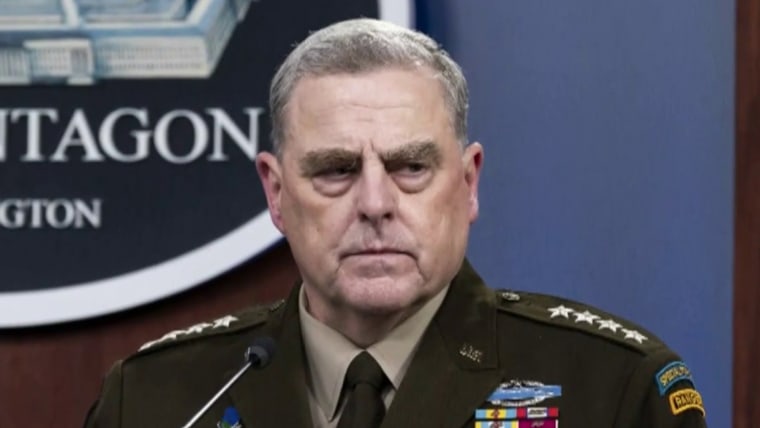
"If we're going to attack, I'm going to call you ahead of time. It's not going to be a surprise," Milley is quoted as saying.
"We're not going to have a fight," Milley told him, according to the book.
Li replied, "Okay."
"I take you at your word," Li said.
Trump laced into Milley in a statement, calling the general a "dumb---" and the details of the story "Fake News."
"For the record, I never even thought of attacking China — and China knows that. The people that fabricated the story are sick and demented, and the people who print it are just as bad," he said in the statement.
The book, set to be released Sept. 21, also recounted a phone conversation Milley had with House Speaker Nancy Pelosi after the Jan. 6 violence at the Capitol, which Pelosi blamed on an "unhinged" Trump. Pelosi said in January that she spoke to Milley about "preventing an unstable president from initiating military hostilities or accessing the launch codes and ordering a nuclear strike."
"I can guarantee you, you can take it to the bank, that there'll be, that the nuclear triggers are secure and we're not going to do — we're not going to allow anything crazy, illegal, immoral or unethical to happen," Milley told her, according to a transcript of the call obtained by the authors.
"The president alone can order the use of nuclear weapons. But he doesn't make the decision alone. One person can order it, several people have to launch it," he said later in the conversation.
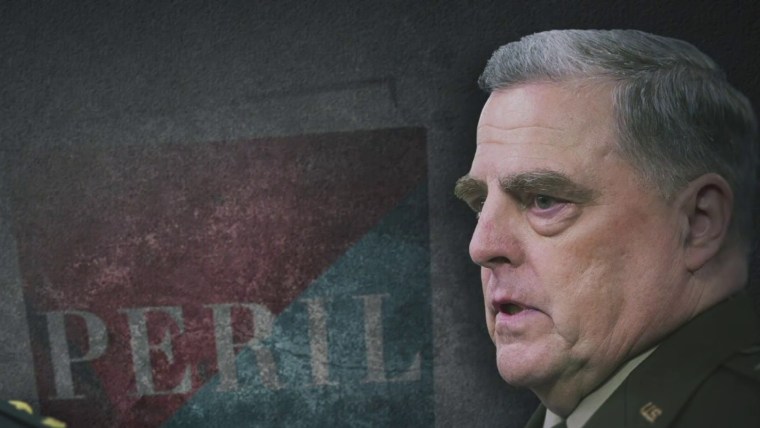
Joint Chiefs Chairman Milley sought to avert conflict with China over Trump fears, new book reports
02:00
After the call, Milley summoned senior officers from the National Military Command Center to go over the procedures for launching nuclear weapons, the book said. He told the officers that if they got a call, "you do the procedure. You do the process. And I'm part of that procedure," he said — making sure he was in the loop on any planned military actions, the book said.
Those scenarios didn't come to fruition.
The book also revealed a previously unreported call between then-Vice President Mike Pence and former Vice President Dan Quayle in late December. Pence was seeking advice about Trump's demand that he refuse to recognize the election results during the electoral vote count on Jan. 6.
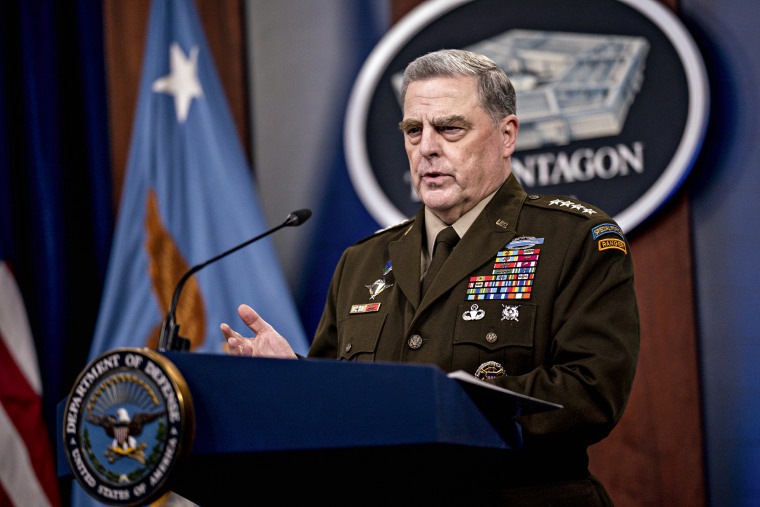
Mark Milley, chairman of the Joint Chiefs of Staff, speaks during a news conference at the Pentagon in Arlington, Va., on Sept. 1.Andrew Harrer / Bloomberg via Getty Images
Quayle thought Trump's suggestion was "preposterous and dangerous," according to the book. He told Pence: "You have no flexibility on this. None. Zero. Forget it. Put it away."
Pence told him, "I've been trying to tell Trump," but "there are other guys there saying I have this power."
Friday, August 9, 2024
The Supreme Court just gave presidents superpowers and rules ex-presidents have broad immunity, dimming chance of a pre-election Trump trial
The Supreme Court opinion in former President Donald Trump's immunity case is photographed Monday, July 1, 2024. In a historic ruling the justices said for the first time former presidents can be shielded from prosecution for at least some of what they do in the The Supreme Court on Monday ruled for the first time that former presidents have some immunity from prosecution, extending the delay in the Washington criminal case against Donald Trump on charges he plotted to overturn his 2020 presidential election loss and all but ending prospects the former president could be tried before the November election.
In a historic 6-3 ruling, the court's conservative majority, including the three justices appointed by Trump. returned his case to the trial court to determine what is left of special counsel Jack Smith's indictment The outcome means additional delay before Trump could face trial.
The court's decision in a second major Trump case this term, along with its ruling rejecting efforts to bar him from the ballot because of his actions following the 2020 election, underscores the direct and possibly uncomfortable role the justices are playing in the November election.
"Under our constitutional structure of separated powers, the nature of presidential power entitles a former president to absolute immunity from criminal prosecution for actions within his conclusive and preclusive constitutional authority," Chief Justice John Roberts wrote for the court. "And he is entitled to at least presumptive immunity from prosecution for all his official acts. There is no immunity for unofficial acts."
The three liberal justices dissented.
In a scathing dissent she read from in the courtroom, Justice Sonia Sotomayor said, "Because our Constitution does not shield a former President from answering for criminal and treasonous acts, I dissent." Sotomayor said the decision "makes a mockery of the principle, foundational to our Constitution and system of government, that no man is above the law."
The protection afforded presidents by the court, she said, "is just as bad as it sounds, and it is baseless."
Trump posted in all capital letters on his social media network shortly after the decision was released: "BIG WIN FOR OUR CONSTITUTION AND DEMOCRACY. PROUD TO BE AN AMERICAN!"
The Supreme Court’s ruling in
Trump v. the United States has unmoored presidential policymaking, including in foreign affairs, from the rule of law. The impact of this epic judgment will likely reverberate for years in the nation’s domestic and foreign policies.
What did the Supreme Court decide in Trump v. United States?
The case before the Supreme Court centered on the August 2023 indictment [PDF] charging former President Donald Trump with violating numerous federal criminal statutes when he sought to overturn the results of the last presidential election prior to leaving office on January 20, 2021. Part of the indictment covers Trump’s alleged role in the January 6 insurrection on Capitol Hill that year.
Trump’s appeal to the Supreme Court revolved around distinguishing official from unofficial acts of a president and the scope of a president’s immunity from criminal prosecution after leaving office. The majority ruled that a president has absolute immunity from criminal liability for conduct “within his exclusive sphere of constitutional authority.” They further found that the president enjoys “presumptive immunity” for “acts within the outer perimeter of his official responsibility…unless the Government can show that applying a criminal prohibition to that act would pose no ‘dangers of intrusion on the authority and functions of the Executive Branch.’” Not surprisingly, the court found that a president enjoys no immunity under federal criminal law to commit unofficial acts.
As to the specific allegations against Trump in the government’s case, the court ruled that his alleged efforts to pressure the Justice Department to conduct sham investigations into election fraud were actions taken within his exclusive constitutional powers and therefore absolutely immune from prosecution.
The majority found that his attempt to pressure Vice President Mike Pence to take certain acts in connection with the electoral vote certification process involved official conduct, and were at least presumptively immune from prosecution. The court reasoned similarly regarding Trump’s controversial tweets and public address in the lead up to the violent march on Capitol Hill. The majority left it to the lower courts to determine whether Trump should receive immunity for these acts.
What does the ruling mean for U.S. democracy and the electoral process?
The immediate consequence of the ruling—and of the monthslong delay in delivering it—is that the Supreme Court has deprived Americans voting in the November 2024 presidential election a jury trial to determine whether one of that race’s candidates violated federal criminal law in connection with the 2020 election.
If Trump becomes the next president, he could shut down the entire prosecution against him by using his executive authority (regardless of the immunity judgment). If he loses the election in November, his trial will likely plod through the federal judiciary with appeals over what constitutes an official or unofficial act and whether presumptive immunity survives.
Remarkably, the court’s ruling would permit a future president to ask an executive branch official to violate a federal criminal statute in connection with elections [PDF], and it would grant that president at least presumptive immunity for those actions. A president could thus be emboldened, for example, to weaponize the Justice Department in an attempt to overturn state vote tallies and facilitate fraudulent elector rolls for the Electoral College.
However, the court did not extend any immunity to the vice president or other executive branch officials, so they would remain subject to federal criminal prosecution, even if they were to break the law at a president’s behest. Without a presidential pardon, these officials could be indicted after the president leaves office. For any federal lawyers involved in criminal conduct, state bar associations could disbar them.
What impact could the ruling have on the president’s powers in foreign policy and national security?
The court has deeply undermined the United States’s credibility in promoting the rule of law overseas, and it may have opened the door for U.S. presidents to commit criminal acts in foreign policy or national security without legal consequence. Under the Constitution, as the court’s ruling confirmed, presidents are granted various powers in the realm of foreign relations, including commanding the armed forces, making treaties, recognizing foreign governments, and overseeing intelligence gathering.
The court’s ruling gives wide room for presidents to commit abuses previously checked by assumed restraints, particularly under federal criminal law. These abuses include:ordering the military to invade a foreign country and commit genocide against a minority religious group;
ordering the military to commit major war crimes and torture against a civilian population in an enemy nation during an armed conflict;
instructing federal officials to falsify documents required for the sale of U.S. weapons and munitions to a foreign purchaser under the Arms Export Control Act;
sharing highly classified national security information (and making no attempt to declassify it) with a foreign leader; and
ordering the U.S. Border Patrol to massacre hundreds of sleeping migrants camped on the U.S.-Mexico border.
While in office, a president who had engaged in any of the above acts could still, of course, be impeached by Congress for “high Crimes and Misdemeanors.” Military personnel and other executive branch officials who comply with or aid the president in these actions would risk prosecution under the Uniform Code of Military Justice or the federal criminal code. As noted earlier, they could also seek presidential pardons for their illegal conduct. But military discipline guided by the rule of law would be dangerously disrupted.
Will the ruling have any implications for the U.S. in international legal forums?
The ruling has no practical effect for International Court of Justice (ICJ) cases in which the United States would be a party. The ICJ adjudicates only state responsibility, and thus a president’s immunity under U.S. law would not affect ICJ deliberations.
If a U.S. president (sitting or former) were to be investigated by the International Criminal Court (ICC), whether or not the United States is party to the Rome Statute [PDF] that established the ICC, it would not recognize the immunity granted to them by the Supreme Court. Article 27 of the Rome Statute explicitly denies the protection of immunities granted to any official.
The ICC affords any nation the initial opportunity to investigate and decide whether to prosecute individuals accused of any of the offenses named by the Rome Statute (genocide, crimes against humanity, war crimes, aggression) and in the result avoid ICC action. However, if a sitting or ex-president were to invoke immunity to block a domestic inquiry, it would ironically expose them directly to an ICC investigation.
Smith's office declined to comment on the ruling.
Senate Majority Leader Chuck Schumer denounced the ruling as "a disgraceful decision," made with the help of the three justices that Trump appointed himself.
"It undermines SCOTUS's credibility and suggests political influence trumps all in our courts today," the New York Democrat said on X, the platform formerly known as Twitter.
The justices knocked out one aspect of the indictment. The opinion found Trump is "absolutely immune" from prosecution for alleged conduct involving discussions with the Justice Department.
Trump is also "at least presumptively immune" from allegations that he tried to pressure Vice President Mike Pence to reject certification of Democrat Joe Biden's electoral vote win on Jan. 6, 2021. Prosecutors can try to make the case that Trump's pressure on Pence still can be part of the case against him, Roberts wrote.
The court directed a fact-finding analysis on one of the more striking allegations in the indictment -- that Trump participated in a scheme to enlist fake electors in battleground states won by Biden who would falsely assert that Trump had won. Both sides had dramatically different interpretations as to whether that effort could be construed as official, and the conservative justices said determining which side is correct would require additional analysis at the trial court level.
That work will fall to U.S. District Judge Tanya Chutkan, who would preside over Trump's trial.
Trump still could face a trial, said Notre Dame law professor Derek Muller. "But the fact remains that it is almost impossible to happen before the election."
David Becker, an election law expert and the executive director of the nonprofit Center for Election Innovation and Research, called the breadth of immunity granted to Trump "incredibly broad" and "deeply disturbing."
"Almost anything that a president does with the executive branch is characterized as an official act," he said on a call with reporters following the ruling. "I think putting aside this particular prosecution, for any unscrupulous individual holding the seat of the Oval Office who might lose an election, the way I read this opinion is it could be a roadmap for them seeking to stay in power."
Becker also lamented the time the Supreme Court took with the ruling, saying Americans had an interest in knowing the result sooner given Trump's candidacy in the upcoming presidential election.
The ruling was the last of the term, and it came more than two months after the court heard arguments, far slower than in other epic high court cases involving the presidency, including the Watergate tapes case.
The Republican former president has denied doing anything wrong and has said this prosecution and three others are politically motivated to try to keep him from returning to the White House.
In May, Trump became the first former president to be convicted of a felony, in a New York court. He was found guilty of falsifying business records to cover up a hush money payment made during the 2016 presidential election to a porn actor who says she had sex with him, which he denies. He still faces three other indictments.
Smith is leading the two federal probes of the former president, both of which have led to criminal charges. The Washington case focuses on Trump's alleged efforts to overturn the 2020 election after he lost to Biden. The case in Florida revolves around the mishandling of classified documents. A separate case, in Georgia, also turns on Trump's actions after his defeat in 2020.
If Trump's Washington trial does not take place before the 2024 election and he is not given another four years in the White House, he presumably would stand trial soon thereafter.
But if he wins, he could appoint an attorney general who would seek the dismissal of this case and the other federal prosecution he faces. He could also attempt to pardon himself if he reclaims the White House. He could not pardon himself for the conviction in state court in New York.
The Supreme Court that heard the case included three justices appointed by Trump — Amy Coney Barrett, Neil Gorsuch and Brett Kavanaugh — and two justices who opted not to step aside after questions were raised about their impartiality.
Justice Clarence Thomas' wife, Ginni, attended the rally near the White House where Trump spoke on Jan. 6, 2021, though she did not go the Capitol when a mob of Trump supporters attacked it soon after. Following the 2020 election, she called the outcome a "heist" and exchanged messages with then-White House chief of staff Mark Meadows, urging him to stand firm with Trump as he falsely claimed that there was widespread election fraud.
Justice Samuel Alito said there was no reason for him to step aside from the cases following reports by The New York Times that said flags similar to those carried by the Jan. 6 rioters flew above his homes in Virginia and on the New Jersey shore. His wife, Martha-Ann Alito, was responsible for flying both the inverted American flag in January 2021 and the "Appeal to Heaven" banner in the summer of 2023, he said in letters to Democratic lawmakers responding to their recusal demands.
Trump's trial had been scheduled to begin March 4, but that was before he sought court-sanctioned delays and a full review of the issue by the nation's highest court.
Before the Supreme Court got involved, a trial judge and a three-judge appellate panel had ruled unanimously that Trump can be prosecuted for actions undertaken while in the White House and in the run-up to Jan. 6.
"For the purpose of this criminal case, former President Trump has become citizen Trump, with all of the defenses of any other criminal defendant," the appeals court wrote in February. "But any executive immunity that may have protected him while he served as President no longer protects him against this prosecution."
Chutkan ruled against Trump's immunity claim in December. In her ruling, Chutkan said the office of the president "does not confer a lifelong 'get-out-of-jail-free' pass."
"Former Presidents enjoy no special conditions on their federal criminal liability," Chutkan wrote. "Defendant may be subject to federal investigation, indictment, prosecution, conviction, and punishment for any criminal acts undertaken while in office."
CNN —
With its immunity ruling on Monday, the Supreme Court granted former President Donald Trump’s wish of all but guaranteeing that his criminal trial for trying to overturn the 2020 presidential election will not go to trial before the 2024 election in November.
It also granted presidents in general a definitive “absolute immunity” from prosecution for core official acts and said presidents should be presumed immune for a much more expansive list of acts.
Related article
In the view of the majority comprised of the six conservative justices on the court, the decision does not place presidents in general, and Trump in particular, above the law. But the three liberals dissented with a warning about how elevating a president will affect American democracy.
The decision has the near-term result of delaying Trump’s trial while a court in Washington, DC, considers which criminal activity that Trump is accused of can be considered “unofficial.” It also has the long-term effect of placing presidents in a different system of justice than other Americans.
Here are key lines from a landmark ruling:
What is this new immunity?
Chief Justice John Roberts explains it in the majority opinion as including absolute immunity for some actions and a presumption of immunity for others.
We conclude that under our constitutional structure of separated powers, the nature of Presidential power requires that a former President have some immunity from criminal prosecution for official acts during his tenure in office. At least with respect to the President’s exercise of his core constitutional powers, this immunity must be absolute. As for his remaining official actions, he is also entitled to immunity. At the current stage of proceedings in this case, however, we need not and do not decide whether that immunity must be absolute, or instead whether a presumptive immunity is sufficient.
Why does a president need this immunity?
So that he can act boldly as president and take actions without fear of later prosecution clouding his judgement, according to the court. Here’s Roberts:
Potential criminal liability, and the peculiar public opprobrium that attaches to criminal proceedings, are plainly more likely to distort Presidential decisionmaking than the potential payment of civil damages.
The hesitation to execute the duties of his office fearlessly and fairly that might result when a President is making decisions under “a pall of potential prosecution,” … raises “unique risks to the effective functioning of government.”
What does it say in the Constitution about presidents getting special immunity?
Nothing. But that’s no problem, according to Roberts.
True, there is no “Presidential immunity clause” in the Constitution. But there is no “‘separation of powers clause’” either. … Yet that doctrine is undoubtedly carved into the Constitution’s text by its three articles separating powers and vesting the Executive power solely in the President.
How far does this immunity extend?
A president gets “at least a presumptive immunity” even for acts “within the outer perimeter of his official responsibility,” according to the court. But it’s careful to add that he gets no immunity for “unofficial acts” – and despite the broad reach of the immunity, the court argues presidents are still accountable.
The President enjoys no immunity for his unofficial acts, and not everything the President does is official. The President is not above the law. But Congress may not criminalize the President’s conduct in carrying out the responsibilities of the Executive Branch under the Constitution.
Are any of the things Trump is accused of in special counsel Jack Smith’s indictment outside this blanket of immunity?
During oral arguments in the case back in April, Trump’s attorney, John Sauer, told Justice Amy Coney Barrett that multiple elements of the indictment would indeed be “private,” or unofficial, acts. These include, for instance, getting an outside attorney to organize slates of false electors.
Barrett, in a concurring opinion on Monday, said she would make clear in the decision what was official versus unofficial. But the majority takes no position and wants the trial court to go through the allegations individually. Trump can then appeal whatever the trial court decides. Here’s Roberts:
… the current stage of the proceedings in this case does not require us to decide whether this immunity is presumptive or absolute. … Because we need not decide that question today, we do not decide it.
Does the majority tell the trial court what might be official or not?
The majority gives quite a bit of detail.
Trump has “absolute immunity” for any instructions or pressure he exerted on his acting attorney general, for instance. Plus, the court won’t allow as evidence any interviews with people who worked in the administration (nullifying much of the evidence gathered by the House select committee that investigated the January 6, 2021, events). And it also won’t let a court consider a president’s motives for taking an action.
Such an inquiry would risk exposing even the most obvious instances of official conduct to judicial examination on the mere allegation of improper purpose, thereby intruding on the Article II interests that immunity seeks to protect.
It’s an open question for the lower court to decide if Trump’s pressure on then-Vice President Mike Pence to disregard the 2020 election results involved “official conduct,” but the Supreme Court put that pressure in the “presumptively immune” category.
We accordingly remand to the District Court to determine in the first instance—with the benefit of briefing we lack—whether Trump’s conduct in this area qualifies as official or unofficial.
The majority thinks Trump’s tweets encouraging people to go to the Capitol and pressure Pence are within the “outer perimeter of his official responsibilities,” but they’re not sure and they expect it will be challenging for the lower court to muddle through these questions.
Why can’t a jury make these decisions?
Juries can’t even consider official acts in terms of a prosecution, according to the Supreme Court.
Allowing prosecutors to ask or suggest that the jury probe official acts for which the President is immune would thus raise a unique risk that the jurors’ deliberations will be prejudiced by their views of the President’s policies and performance while in office. The prosaic tools on which the Government would have courts rely are an inadequate safeguard against the peculiar constitutional concerns implicated in the prosecution of a former President.
So the Supreme Court gave Trump everything he wanted?
It certainly embraced Trump’s theory of immunity and pretty much guaranteed the trial will not happen before the election, although the majority says they were restrained since they rejected his request to completely dismiss the case.
Trump asserts a far broader immunity than the limited one we have recognized. He contends that the indictment must be dismissed because the Impeachment Judgment Clause requires that impeachment and Senate conviction precede a President’s criminal prosecution.
So there is a special system of justice for presidents?
The president is more than a person, according to Roberts.
Like everyone else, the President is subject to prosecution in his unofficial capacity. But unlike anyone else, the President is a branch of government, and the Constitution vests in him sweeping powers and duties. Accounting for that reality—and ensuring that the President may exercise those powers forcefully, as the Framers anticipated he would—does not place him above the law; it preserves the basic structure of the Constitution from which that law derives.
The majority dismisses warnings about a president operating above the laws as “fear mongering on the basis of extreme hypotheticals.” It’s more important to protect the president from political prosecutions, the court says.
The dissents overlook the more likely prospect of an Executive Branch that cannibalizes itself, with each successive President free to prosecute his predecessors, yet unable to boldly and fearlessly carry out his duties for fear that he may be next. … The enfeebling of the Presidency and our Government that would result from such a cycle of factional strife is exactly what the Framers intended to avoid.
Roberts borrows from Trump’s attorneys when he quotes George Washington’s farewell address, in which he warns about factions. The problem with that particular quote, as I found earlier this year, is that Washington also warned about elevating a person above the law.
Does the court mention the politics of today?
Roberts says the court’s considerations are more far-reaching than what’s happening at the moment.
This case poses a question of lasting significance: When may a former President be prosecuted for official acts taken during his Presidency? Our Nation has never before needed an answer. But in addressing that question today, unlike the political branches and the public at large, we cannot afford to fixate exclusively, or even primarily, on present exigencies. In a case like this one, focusing on “transient results” may have profound consequences for the separation of powers and for the future of our Republic.
Did it say anything about Smith?
The majority did not weigh in on the brewing argument among conservatives that Smith should not even have a job and that his role as a special counsel is unconstitutional. But Justice Clarence Thomas endorsed the idea in a concurring opinion.
In this case, there has been much discussion about ensuring that a President “is not above the law.” But, as the Court explains, the President’s immunity from prosecution for his official acts is the law. … In that same vein, the Constitution also secures liberty by separating the powers to create and fill offices. And, there are serious questions whether the Attorney General has violated that structure by creating an office of the Special Counsel that has not been established by law.
What did Barrett say about alternate electors?
Barrett, a Trump appointee, wrote her own concurrence in which she disagreed with the majority on some key points. She said they could easily have expressed that some of Trump’s conduct was unofficial.
Sorting private from official conduct sometimes will be difficult—but not always. Take the President’s alleged attempt to organize alternative slates of electors. … In my view, that conduct is private and therefore not entitled to protection. … a President has no legal authority—and thus no official capacity—to influence how the States appoint their electors. I see no plausible argument for barring prosecution of that alleged conduct.
What was in the blistering dissent?
Writing for the three liberals on the court, Justice Sonia Sotomayor blasted the majority as inventing an “atextual, ahistorical, and unjustifiable immunity that puts the President above the law.” She said the court makes it difficult to imagine what might be “unofficial” conduct on the part of the president.
In sum, the majority today endorses an expansive vision of Presidential immunity that was never recognized by the Founders, any sitting President, the Executive Branch, or even President Trump’s lawyers, until now. Settled understandings of the Constitution are of little use to the majority in this case, and so it ignores them. … In fact, the majority’s dividing line between “official” and “unofficial” conduct narrows the conduct considered “unofficial” almost to a nullity.
The majority “pays lip service” to the idea that presidents are not above the law “but it then proceeds to place former Presidents beyond the reach of the federal criminal laws for any abuse of official power.”
Thursday, August 8, 2024
THE TRUMP CRIME FAMILY
If Republicans are truly worried about members of the first family improperly benefitting from their name, Mehdi says there are two people besides Hunter Biden that they should be looking at: Ivanka Trump and Jared Kushner.
With each passing day away from Washington, former President Donald Trump’s grievances continue unabated. And those complaints appear to be driving away two of the people who were closest to him during his White House tenure: his daughter Ivanka Trump and son-in-law, Jared Kushner.
Sometimes the former President complains for several hours about the “stolen” 2020 election. Other times, his frustrations emerge in fits and starts – more likely when he is discussing his hopeful return to national politics. And while he often has a rotating audience of cheering listeners, the gap between Trump and his daughter and son-in-law grows wider by the week, according to 12 former Trump White House officials, former administration officials, family friends, acquaintances and members of Trump’s team who spoke with CNN about changes to the former President’s current inner circle.
A large part of the reason for the separation is Trump’s constant harping on the past and his inability to move on. The former President has also started to question the role that Kushner – one of the few people who were able to stay close to Trump throughout his two presidential campaigns and White House tenure – has played in his presidential legacy.
Ivanka Trump has also struggled to undo the entanglements caused by the years at her father’s side in the White House, as she seeks a less complicated life for her family, according to two acquaintances. They described her as having to walk a fine line between embracing her father and distancing herself from his election lies.
Having spent much of the last five-and-a-half years in close proximity to him, Ivanka Trump and Kushner were rarely seen with him in the months leading up to the former President’s seasonal shift from living at Mar-a-Lago in Palm Beach, Florida, to living in a cottage at his private golf club in Bedminster, New Jersey.
“They weren’t around for the usual spring and summer events at Mar-a-Lago,” says one clubgoer and family friend, noting the absence of Trump’s elder daughter and the couple’s three young children.
Simultaneously, the disappearance of Kushner – once the ringleader of Trump’s policy operations – was also apparent. A person familiar with Kushner says there were visits from the Kushner/Trump family to Mar-a-Lago before Trump’s move North, but they were sparse, averaging once every three to four weeks. The physical distance between them was not far: after leaving Washington, Kushner and Ivanka Trump moved to a Miami high-rise to await the construction of their mansion on a nearby private island.
Kushner’s presence, physically and virtually, has become increasingly rare as it became clear that his father-in-law remained preoccupied with the 2020 election, according to one person familiar with the situation.
“He was kind of like a parent who sticks around less and less each morning while they’re transitioning their kid to day care,” this person said.
Kushner moves to the side
It wasn’t the distance that kept Kushner away, say those who know his thinking – it was the desire to be far from Trump’s constant stream of contempt, and the chorus of voices cheering him on.
“Trump always has an array of characters around him,” says a person who worked in the administration.
Around mid-March, some of Trump’s most trusted advisers began urging him to bring someone onto his team who could oversee daily operations and help organize his candidate meetings, fundraising requests and endorsement vetting process.
“I don’t think it’s accurate to say he needed a new Jared, because Jared was always more of a policy guy inside the White House, but there was definitely a sense that some part of the puzzle was missing and it was contributing to a lot of internal confusion and chaos,” said a former White House official.
Eventually, Trump brought on Susie Wiles, a Florida-based consultant who had earned his trust and was a familiar face to others on his payroll. But the frequency of Wiles’ appearances, as well as her overall involvement, has also decreased since Trump relocated to Bedminster for the summer, according to one of the people involved with his operation.
Another consistent presence is that of Donald Trump Jr, whose penchant for politics has grown in the years since his father entered the political scene and who has become an increasingly trusted adviser to the former real estate mogul.
Kushner is not helping Trump cook up plans for a rally later this month, nor is he intensely involved with the former President’s endorsement decisions or frequent public statements, which, sans a social media presence, come via news releases from Trump’s leadership PAC, Save America – again, something Kushner has veered away from.
Without input from his elder daughter and her husband, Trump is isolated from their influence, though the person close to Kushner does note he “still speaks on the phone” to the former President.
Now Trump finds himself more often in the company of an ever-changing circle of advisers. Trump allies say he is once again interacting with characters who should require supervision – noting that he has been in frequent touch with One America News anchor Christina Bobb, a prolific proponent of far-fetched theories about the 2020 election, in addition to MyPillow CEO Mike Lindell, who has encouraged Trump to keep challenging the 2020 election results in several states.
A member of Trump’s team tells CNN the former President has “always had siloed relationships” with various people and that even in the White House – with Kushner ostensibly down the hall – Trump could frequently be “running his own play.” This person notes Trump’s cadre of recent influencers is akin to his unconventional way of eliciting opinion.
“There are other circles around him, yes,” says this person, who doesn’t argue there are questionable characters in the ear of the former President, “but that doesn’t mean he doesn’t also have very reasonable and buttoned-up people there as well.”
The person close to Kushner adds that the group off whom Trump bounces his most off-the-wall and questionable theories is, while conspiratorial in nature, not completely out of the realm of a host of “regulars” with whom he has held court over the years.
“The stakes [now] are also less than they were when he was in the White House,” says the source.
Eroded trust
Trump has privately started to question Kushner’s contributions to his legacy. One person who spoke with the former President in the last two weeks recounted a conversation in which Trump complained about Kushner inking a book deal that he thinks his son-in-law will use to take credit for some of his achievements.
Another source confirms there is jealousy from Trump about Kushner’s book, which a Kushner associate says was a “seven-figure deal” with Broadside Books, the conservative branch of mega-publisher HarperCollins. Trump, who has lately been helping with several journalists’ in-the-works books about his presidency, has yet to announce a deal of his own.
“He’s always been suspicious of Jared,” this person said, noting that Trump has previously discounted Kushner’s role in some of the key policies he enacted as president, including Middle East peace deals and criminal justice revisions.
Two people familiar with conversations Trump has had since his arrival in May at Bedminster say he questioned whether Kushner “accomplish[ed] peace in the Middle East after all” after tensions between Israel and Hamas erupted into a violent series of airstrikes last month.
“It is not a secret President Trump doesn’t like when he thinks other people are getting attention for something he feels he has facilitated,” says another former Trump White House official. “There’s a sweet spot between saying nothing about work you did and saying too much that everyone has to find – or else he gets triggered.”
A person who works with Trump now disputes that the former President has been vocal about disloyalty to Kushner, noting that several of the authors who have interviewed the former President for their books have asked directly whether Trump blames Kushner for his election loss.
“Every time, he’s answered definitively, ‘no,’ on the record,” says the person.
Those close to Kushner laugh off the idea of an estrangement, saying Trump is provocative at times because that is who he is. They note Kushner is long used to the occasional Trump backlash, and it doesn’t bother him.
“He knows Trump acknowledges his successes,” says the person close to Kushner.
Still, the Kushner intimates make no bones about the fact that the couple disagrees with the former President’s current pursuits. It’s clear that the close advisory relationship is no more.
The distance Kushner and Ivanka Trump have put between their current life and the former President has also helped, but that gap that is soon to close.
Road trip
For the last week, Kushner, Ivanka Trump and their children have been on a summer road trip, from Miami to, eventually, Bedminster. It’s the sort of summer activity millions of American families partake in, but the Kushner clan has made stop-offs along the way with a who’s who of Trump’s former administration.
Over the weekend, they were in Kiawah, South Carolina, staying with former US Ambassador to the United Nations Nikki Haley, who has made no secret of her desire to run for president but remains estranged from Trump’s inner circle after publicly criticizing his response to the 2020 election. The Kushners and the Haleys were spotted on a double date at a popular local restaurant. Haley said in April that she would not make a run for the White House in 2024 if Trump decides he will run – or she would at least discuss that scenario with him.
“That’s something that we’ll have a conversation about at some point if that decision is something that has to be made,” she said at a news conference.
Haley, like the Kushners, added that she has put space between herself and the former President, noting she had not talked to him since after the election but before the January 6 storming of the Capitol by a mob of his supporters.
The source close to Kushner downplayed the visit with Haley, saying South Carolina was just “one of the states along the way” on their drive.
Monday found them in Nashville, paying a visit to former State Department spokeswoman Morgan Ortagus, a close friend of Ivanka Trump’s and frequent guest on Fox News. During the Trump administration, Ortagus worked for then-Secretary of State Mike Pompeo, who has in recent months toyed with the idea of a run for the White House.
The Kushner family will eventually get to their East Coast digs, and the person close to Kushner noted they will also spend time at their old apartment in New York City, in addition to Bedminster. They’ll also perhaps visit the Hamptons, the summer playground of the rich and connected.
In Bedminster, the Kushner cottage and the Trump cottage are separated by mere tens of feet, about as close as the families have been for an extended period since the White House. Kushner’s allies say that won’t be a problem for him, as the two men are “not at odds,” as one describes their relationship. Another friend of Kushner’s says the men have a “good relationship, but [Kushner] is not anywhere near his political orbit.”
Things might be slightly more challenging for Ivanka Trump, though, who has for the last several months walked a tightrope between Trump, her father, and Trump, the wounded loser of a contentious election.
For the time being, she is not getting involved in the rhetoric, nor the unknowns that could be on the horizon for her father – politics, business, relationships or investigations.
“She is being very present, in the moment,” says a person who has worked closely with her for the last several years. “She’s not concerned.”
“After spending four years serving and traveling the country extensively, Ivanka is taking time with family and friends,” her former chief of staff, Julie Radford, tells CNN.
Explaining why the former President’s life is not simpatico with his daughter’s, one of the people close to Kushner said, “She is focused on her children, and spending time with them, period.”
“Listen, you lose an election, things happen, people get over it, they move on, these are natural consequences,” says the friend of Kushner’s.
The person familiar with Trump’s thinking insists no one has been “removed” from his inner circle and that whatever the status of the relationship, the blurred lines among employee, adviser and son-in-law exist because they’ve both made them such.
“This is family, and family is in its own category. Its own unique category,” the person said.
Tuesday, July 30, 2024
Project 2025 Exposed: The Trump allies seeking a Christian nationalist coup
Project 2025: A wish list for a Trump presidency, explained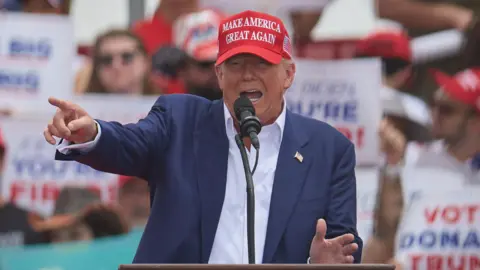 EPA
EPA
A proposed Republican party platform has been approved at the party’s national convention, but a much more detailed proposal from a conservative think tank has also been drawing attention.
Project 2025 was created by the Heritage Foundation and runs for nearly 900 pages.
The document calls for the sacking of thousands of civil servants, expanding the power of the president, dismantling the Department of Education, sweeping tax cuts, a ban on pornography, halting sales of the abortion pill, and more.
There is agreement between many parts of the official Republican platform and Project 2025, although the think-tank document is much more detailed and in some policy areas goes much further than the party line.
There is a sharper contrast between the two when it comes to the issue of abortion, with Heritage urging much more aggressive anti-abortion policies.
Who wrote Project 2025?
It is common for Washington think tanks of all political stripes to propose policy wish lists for potential governments-in-waiting.
The conservative Heritage Foundation first produced policy plans for future Republican administrations in 1981, when Ronald Reagan was about to take office.
It has produced similar documents in connection with subsequent presidential elections, including in 2016, when Trump won the presidency.
A year into his term, the think tank boasted that the Trump White House had adopted nearly two-thirds of its proposals.
The Project 2025 report was unveiled in April 2023, but liberal opposition to the document has ramped up now that Trump has extended his polling lead.
The Republican nominee himself has distanced himself from the proposal.
"I know nothing about Project 2025," he posted on his social media website, Truth Social. "I have no idea who is behind it.
"I disagree with some of the things they're saying and some of the things they’re saying are absolutely ridiculous and abysmal."
But the team that created the project is chock-full of former Trump advisers, including director Paul Dans, who was chief of staff at the Office of Personnel Management while Trump was president.
Russell Vought, another former Trump administration official, wrote a key chapter in the document and also serves as the Republican National Committee’s 2024 platform policy director.
More than 100 conservative organisations contributed to the document, Heritage says, including many that would be hugely influential in Washington if Republicans took back the White House.
The Project 2025 document sets out four main policy aims: restore the family as the centrepiece of American life; dismantle the administrative state; defend the nation's sovereignty and borders; and secure God-given individual rights to live freely.
Here's an outline of several of its key proposals.
Government
Project 2025 proposes that the entire federal bureaucracy, including independent agencies such as the Department of Justice, be placed under direct presidential control - a controversial idea known as "unitary executive theory".
In practice, that would streamline decision-making, allowing the president to directly implement policies in a number of areas.
The proposals also call for eliminating job protections for thousands of government employees, who could then be replaced by political appointees.
The document labels the FBI a "bloated, arrogant, increasingly lawless organization". It calls for drastic overhauls of this and several other federal agencies, as well as the complete elimination of the Department of Education.
What does the Republican party platform say?
The party platform includes a proposal to "declassify government records, root out wrongdoers, and fire corrupt employees", pledges to slash regulation and government spending. But it stops short of proposing a sweeping overhaul of federal agencies as outlined in Project 2025.
Immigration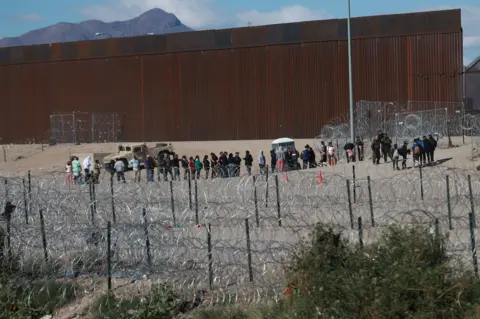 EPA
EPA
Increased funding for a wall on the US-Mexico border - one of Trump's signature proposals in 2016 - is proposed in the document.
Project 2025 also proposes dismantling the Department of Homeland Security and combining it with other immigration enforcement units in other agencies, creating a much larger and more powerful border policing operation.
Other proposals include eliminating visa categories for crime and human trafficking victims, increasing fees on immigrants and allowing fast-tracked applications for migrants who pay a premium.
What does the Republican party platform say?
Not all of those details are repeated in the party platform, but the overall headlines are similar - the party is promising to implement the "largest deportation programme in American history".
What a Trump second term would look like
BBC

What a Donald Trump second term would look like
If he returns to the White House by winning the 2024 election, here is what he has said he wants to do.
Climate and economy
The document proposes slashing federal money for research and investment in renewable energy, and calls for the next president to "stop the war on oil and natural gas".
Carbon-reduction goals would be replaced by efforts to increase energy production and energy security.
The paper sets out two competing visions on tariffs, and is divided on whether the next president should try to boost free trade or raise barriers to imports.
But the economic advisers suggest that a second Trump administration should slash corporate and income taxes, abolish the Federal Reserve and even consider a return to gold-backed currency.
What does the Republican party platform say?
The party platform does not go as far as Project 2025 in these policy areas. The platform instead talks of bringing down inflation and drilling for oil to reduce energy costs, but is thin on specific policy proposals.
Abortion and family
Project 2025 does not call outright for a nationwide abortion ban.
However, it proposes withdrawing the abortion pill mifepristone from the market, and using existing but little-enforced laws to stop the drug being sent through the post.
The document suggests that the department of Health and Human Services should "maintain a biblically based, social science-reinforced definition of marriage and family".
What does the Republican party platform say?
On this issue at least, the document differs fairly substantially from the Republican platform, which only mentions the word "abortion" once. The platform says abortion laws should be left to individual states and that late-term abortions (which it does not define) should be banned.
It adds that that access to prenatal care, birth control and in-vitro fertilisation should be protected. The party platform makes no mention of cracking down on the distribution of mifepristone.
Tech and education
Under the proposals, pornography would be banned, and tech and telecoms companies that allow access would be shut down.
The document calls for school choice and parental control over schools, and takes aim at what it calls "woke propaganda".
It proposes to eliminate a long list of terms from all laws and federal regulations, including "sexual orientation", "gender equality", "abortion" and "reproductive rights".
Project 2025 aims to end diversity, equity and inclusion programs in schools and government departments as part of what it describes as a wider crackdown on "woke" ideology.
What does the Republican party platform say?
Project 2025's proposals in this policy area are broadly reflected in the Republican platform, which in addition to calling for the abolishing the Department of Education, aims to boost school choice and parental control over education and criticises what the party calls the "inappropriate political indoctrination of our children".
Social Security
Although Heritage has long supported reforming the country's public pension plan, Project 2025 barely touches this third rail of American politics.
What does the Republican party platform say?
The platform says Social Security is a "lifeline" for millions of retired Americans and Republicans will "restore Economic Stability to ensure the long-term sustainability" of the programme.
The plan's future
Project 2025 is backed by a $22m (£17m) budget and includes strategies for implementing policies immediately after the presidential inauguration in January 2025.
Heritage is also creating a database of conservative loyalists to fill government positions, and a programme to train those new workers.
Democrats led by Jared Huffman, a congressman from California, have launched a Stop Project 2025 Task Force.
And many of the proposals would likely face immediate legal challenges from Trump's opponents if implemented.
Carbon-reduction goals would be replaced by efforts to increase energy production and energy security.
The paper sets out two competing visions on tariffs, and is divided on whether the next president should try to boost free trade or raise barriers to imports.
But the economic advisers suggest that a second Trump administration should slash corporate and income taxes, abolish the Federal Reserve and even consider a return to gold-backed currency.
What does the Republican party platform say?
The party platform does not go as far as Project 2025 in these policy areas. The platform instead talks of bringing down inflation and drilling for oil to reduce energy costs, but is thin on specific policy proposals.
Abortion and family
Project 2025 does not call outright for a nationwide abortion ban.
However, it proposes withdrawing the abortion pill mifepristone from the market, and using existing but little-enforced laws to stop the drug being sent through the post.
The document suggests that the department of Health and Human Services should "maintain a biblically based, social science-reinforced definition of marriage and family".
What does the Republican party platform say?
On this issue at least, the document differs fairly substantially from the Republican platform, which only mentions the word "abortion" once. The platform says abortion laws should be left to individual states and that late-term abortions (which it does not define) should be banned.
It adds that that access to prenatal care, birth control and in-vitro fertilisation should be protected. The party platform makes no mention of cracking down on the distribution of mifepristone.
Tech and education
Under the proposals, pornography would be banned, and tech and telecoms companies that allow access would be shut down.
The document calls for school choice and parental control over schools, and takes aim at what it calls "woke propaganda".
It proposes to eliminate a long list of terms from all laws and federal regulations, including "sexual orientation", "gender equality", "abortion" and "reproductive rights".
Project 2025 aims to end diversity, equity and inclusion programs in schools and government departments as part of what it describes as a wider crackdown on "woke" ideology.
What does the Republican party platform say?
Project 2025's proposals in this policy area are broadly reflected in the Republican platform, which in addition to calling for the abolishing the Department of Education, aims to boost school choice and parental control over education and criticises what the party calls the "inappropriate political indoctrination of our children".
Social Security
Although Heritage has long supported reforming the country's public pension plan, Project 2025 barely touches this third rail of American politics.
What does the Republican party platform say?
The platform says Social Security is a "lifeline" for millions of retired Americans and Republicans will "restore Economic Stability to ensure the long-term sustainability" of the programme.
The plan's future
Project 2025 is backed by a $22m (£17m) budget and includes strategies for implementing policies immediately after the presidential inauguration in January 2025.
Heritage is also creating a database of conservative loyalists to fill government positions, and a programme to train those new workers.
Democrats led by Jared Huffman, a congressman from California, have launched a Stop Project 2025 Task Force.
And many of the proposals would likely face immediate legal challenges from Trump's opponents if implemented.
Friday, June 14, 2024
HIT ALL RUSSIAN ASSETS CLOSE TO FLORIDA COAST BEFORE THEY ESTABLISH A PERMANENT CUBAN BASE
“The Russians have been more active than we’ve seen them in years,” Army Gen. Chris Cavoli, the top commander for NATO and U.S. military operations in Europe, told Congress on Wednesday of Moscow’s undersea capabilities. Russia’s nuclear-powered submarine is now deployed in American waters. The Kazan 561 or K-561 is an advanced Russian Yasen Class nuclear-powered cruise missile submarines. Operated only by Russia, Yasen class submarines are the newest subs in the Russian navy and are known for their sophisticated design, armament, and stealth capabilities. Is its deployment bringing US and Russia to the brink of war.
“Their patrols into the Atlantic and throughout the Atlantic are at a high level most of the time, at a higher level than we’ve seen in years,” Cavoli testified before the House Armed Services Committee. “And this, despite all the efforts they’re undertaking in Ukraine.”
Cavoli’s assessment represents a grave warning for future threats Russia may pose to the U.S. and Ukraine’s other western backers. Though analysts have expressed concerns about Russia’s submarine forces in recent weeks, they have largely centered on the recent attention the Kremlin has focused on its Pacific Fleet, which conducted massive drills last week and which Moscow analyzed and claimed last week has “high readiness.” Those maneuvers were seen in part as an acknowledgement of Moscow and Beijing’s increased partnership.
Putin previously raised concerns in the West in January when he dispatched surface warships to the Atlantic Ocean, including those the U.S. believes can fire hypersonic weapons potentially capable of defeating American missile defenses. Russia fields 11 ballistic missile submarines, which analysts previously assessed it deploys largely off its Arctic coasts.
Cavoli’s comments come at a time of growing consensus that Russia has severely harmed several key elements of its military power through President Vladimir Putin’s decision to invade Ukraine in February 2022 without provocation. A string of high-profile and embarrassing failures since then have exposed endemic issues within the Russian Ministry of Defense, particularly deeply rooted corruption among top commanders, logisticians and those overseeing stockpiles. And confusion and mismanagement on the battlefield has created a veritable meat grinder for Russian ground forces, despite Putin’s decision to continue pressing young men into service and sending them into the fight.
Russia continues to benefit from the sheer size of its forces, as seen in the persistent, grinding combat around cities such as Bakhmut in Ukraine’s east. But analysts have increasingly highlighted the core problems that plague its ground troops.
“Russian forces in Ukraine are operating in decentralized and largely degraded formations throughout the theater, and the current pattern of deployment suggests that most available units are already online and engaged in either offensive or defensive operations,” the independent Institute for the Study of War, which has fastidiously tracked Russian military movements in and around Ukraine, concluded in an analysis note on Sunday.
“It is highly likely that the majority of Russian elements throughout Ukraine are substantially below full strength due to losses taken during previous phases of the war,” the institute stated.
The grave warnings also come as a growing number of Republican lawmakers – and several leading GOP presidential candidates – question the value of U.S. support for Ukraine, saying those resources should instead focus on deterring China.
Rep. Mike Waltz of Florida, a former Green Beret commander, employed this argument on Wednesday, questioning Assistant Secretary of Defense for International Security Affairs Celeste Wallander, who testified alongside Cavoli, about the need to continue dedicating resources to Ukraine when Russia’s military has been devastated.
“Its ground forces that are in Ukraine have been devastated,” Wallander pushed back. But she added that “Russia still retains strategic capabilities” – its nuclear force, the world’s largest – “an air force, cyber and underwater.”
“We should not make the mistake of underestimating Russia’s military capabilities,” Wallander warned, “because the stakes of getting it wrong are too high.”
Subscribe to:
Posts (Atom)