The Supreme Court where nine judges appointed for life make monumental decisions that govern our everyday lives, from the contents of the nation's daily newspapers to what we can do in the privacy of our own homes. With immense power and considerable mystery, the court of final appeal the ultimate interpreter of the Constitution and now mostly following the right. We in our lifetime will be under the scrutiny of this president long after his term ends..........Amor Patriae
Friday, July 15, 2022
ON THE BRINK OF CIVIL WAR
Last week, an anonymous caller told a Republican congressman who voted with Democrats in favor of the infrastructure bill that he and his staff should die. On Monday, Twitter added a warning label to a cartoon video shared by a different Republican congressman in which he assassinated a colleague from across the aisle. On Wednesday, a Black Lives Matter organizer threatened “bloodshed” if New York’s mayor-elect reinstated a controversial anti-crime police unit. On Friday, an interview was released in which former President Donald Trump defended rioters calling for the hanging of his vice president.
In January, a new member of Congress vowed to come to work armed. Another admitted that, barricaded in his office as a mob coursed through the halls of the Capitol on Jan. 6, he thought he might have to use his own gun to defend himself. Still another member of Congress had a gun pointed at him during a town hall meeting. And one of the 10 Republicans who voted to impeach Trump — fearing for the safety of his wife and children — decided not to seek re-election.
At least one noted American historian is comparing today’s pugnacious politics with that of the republic in the years leading up to the Civil War. And indeed, Americans around the country seem to endorse bellicose behavior. According to a survey published on Nov. 1, 18 percent of all Americans (30 percent of Republicans, 17 percent of Independents and 11 percent of Democrats) believe that “patriots” might have to resort to violence to save the country. Another poll earlier in the year found that 46 percent of people thought the country was somewhat or very likely to have another civil war.
Are they right? Does America’s increasingly uncivil behavior mean we are heading toward civil war?
The signs on the road ahead give cause for concern. America suffers from a list of societal and political conditions that predispose it to violence, and the list seems to be growing longer. At the same time, states that have always defended their sovereignty are more and more defiant of federal authority, which they characterize as increasingly intrusive and tyrannical. The Covid-19 pandemic exacerbates political and geographical differences, leading to social warfare in schools and airports and hospitals over mask and vaccination mandates.
This has prompted renewed talk of secession. But that does not mean that civil war is on the horizon. For one thing, talk of secession is still just talk. The slouching of both political parties to their right and left extremes increases numbers and noise on the far edges. But most people have little time for political posturing and zealots’ fantasies.
The bellicose rhetoric and belligerent behavior displayed by and toward some of our elected officials also do not mean a civil war — a military contest between the states — is inevitable or even probable. A more likely scenario is a turbulent era of civil disturbances, armed confrontations, standoffs, threats, assassination attempts and other acts of political violence — in other words, one that is a lot like the last 200 years of American history.
Indeed, much of what we are seeing now has ample precedents. Those precedents don’t make our current circumstances any less ugly, but they do mean that we have been through similar outbreaks before and survived. However, just as civil war is not inevitable, there is no guarantee that the republic will not be fatally weakened or that the union will last — though the tensions we see nationwide seem more likely to produce localized brutishness rather than centralized armed conflict.
As the French political scientist Alexis de Tocqueville noted after touring the United States nearly two centuries ago — when democracy was still an uncommon form of government — what gave the country strength was that Americans had a strong sense of community. Today, the catalog of trends currently eroding that sense of community is depressingly long.
The increased polarization of our political system tops the list. It is a long-term trend, beginning in the 1970s, according to research at the RAND Corporation, that now manifests itself in the demonization of political opponents as primal enemies — tyrants, traitors, terrorists.
Polarization has also contributed to the loss of comity in political discourse, which has turned into crude insults, ad hominem attacks and the notion that profanity displays authenticity. Contemporary political rhetoric is seemingly intended to inflame passions, at times bordering on criminal incitement. Some news channels and the internet (along with foreign influence operations) stoke the differences, and facts are often irrelevant.
This uncivic culture makes vicious attacks and harassment of public officials common, discouraging ordinary people from entering public service while attracting zealots. And some political campaigns have gone to the dark side, with opaque financing and front organizations to evade campaign rules and tinker with the voting process. The mere advertisement that they are doing so calls into question the legitimacy of elections. It is behavior suitable to the Kremlin, not democracy.
Irreconcilable differences on social issues reinforce the political divide. Differences over racial injustice, abortion, gun control, immigration and LGBTQ rights increasingly determine whom one is willing to associate with, reinforcing self-segregation along political lines as we group with like-minded friends and partners.
Thursday, July 14, 2022
DERELICTION OF DUTIES by American Leaders and the Sacrifice of Bataan
The greatest enemy of truth is very often not the lie - deliberate, contrived and dishonest - but the myth - persistent, persuasive and unrealistic. --JFK, June 11, 1962
APRIL, 1942. ROOSEVELT SAID HELP WOULD BE ON THE WAY FOR BATAAN, BUT HE WAS LYING. HE CLAIMED THAT HE COULD NOT GET HELP THROUGH TO THE PHILLIPINES, HOWEVER IN APRIL OF '42 WE HAD THE BATTLESHIPS NEW MEXICO, MISSISSIPPI, IDAHO, COLORADO, MARYLAND AND PENNSYLVANIA IN SERVICE. THE BRAND NEW BATTLESHIP WASHINGTON WAS IN SERVICE ESCORTING SUPPLIES TO MURMANSK. WE COULD SUPPLY THE RUSSIANS BUT NOT OUR OWN TROOPS. THE AIRCRAFT CARRIERS LEXINGTON, SARATOGA, YORKTOWN, ENTERPRISE, HORNET WERE ALL AVAILABLE. THE WASP WAS BUSY ESCORTING SUPPLIES TO MALTA, ONCE AGAIN AT THE EXPENSE OF OUR OWN TROOPS! WHY DID ROOSEVELT DECIDE TO LET THOSE BRAVE SOLDIERS DIE WHILE HE HAD THE FORCE AVAILABLE TO HELP??? The flawed Europe First policy resulted in the death of American soldiers. These ships and troops should have first been allocated to protect American lives. To use our newest battleship to help Uncle Joe instead of making a task force to help Americans is criminal. People like to think Roosevelt had no choice but he did and he made a flawed political choice rather than a good moral choice. We could have taken the battle to the Japanese early on but the Pacific was always given a low priority in comparison with Europe. Since I don't recall Germany bombing us at Pearl Harbor the Europe first choice seems an odd idea that cost many Americans their lives.
I'm still wondering if anyone can tell me what threat Germany was to the U.S. in 1941-42? Why "Europe First"??? Could it have been to help out Stalins regime at the expense of American lives? I just don't see the need for Europe first being in the U.S. strategic intrest at that time. I'd be happy if someone could explain to me how it was strategically better FOR THE USA to be involved in a European war when we were first attacked in the Pacific.
Churchill came away from the Atlantic Conference on August 14, 1941, observing the "astonishing depth of Roosevelt's intense desire for war." Before we entered the war, FDR sent a delegation to the Vatican to get the Pope to endorse Godless communism - he refused. With lend-lease, a.k.a. Lenin-lease, before Pearl Harbor FDR pressed his aides to allocate and speed shipments to the Soviet Union in the strongest possible way. FDR exerted frenetic personal devotion to the cause of lend-lease to the communists, distinctly favoring Russia over Britain (and US) and if you read page 549 volume 3 of The Secret Diaries of Harold Ickes, Ickes makes it clear that in a choice between England and Russia FDR would have abandoned England: "if the (public) attitude had been one of angry suspicion or even resentment, we would have been confronted with the alternative of abandoning Great Britian or accepting communism..." On August 1, 1941 FDR said about planes for Russia, "we must get 'em, even if it necessary to take from our own troops." Ickes said "we ought to come pretty close to stripping ourselves in view of Russian aid." The US sent 150 P-40's (the newest) when we were woefully short. In 1944 Churchill publicly complained about Britain being treated worse than the Soviet Union (in 1943 we sent 5,000 planes to Russia; overall we sent 20,000 planes and 400,000 trucks - twice as many as they had had before the war, 9 million pairs of boots, complete factories as part of $11 billion in aid that was never expected to be paid back). FDR's oil embargo of Japan forcing them South to take oil-rich Dutch Indonesia, is incomprehensible unless you realize FDR did it to relieve Japanese military threats to the Soviet Union.
A big coastal gun is fired from fortified American positions on Corregidor Island, at the entrance to Manila Bay on the Philippines, on May 6, 1942. (AP Photo) #
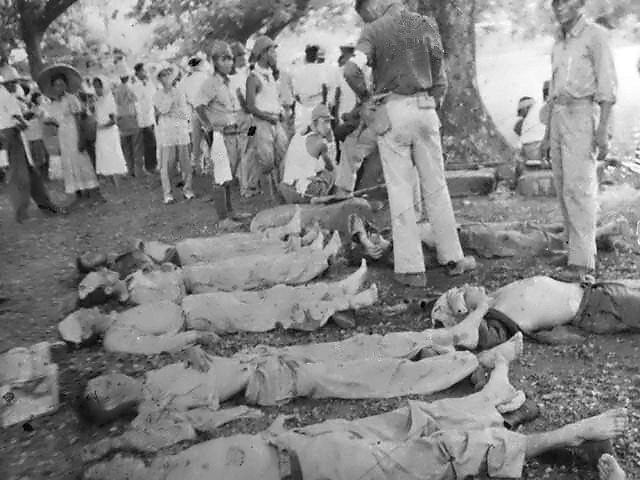
General King surrendered 76,000 American and Filipino soldiers on 9 April 1942. Approximately 1,500 of that total were transferred or escaped to Corregidor, which meant that about 74,000 men were going with him into captivity—far more than the 40,000 prisoners the Japanese expected to house and feed. The result was one of the Pacific War’s worst atrocities.
Over the next three days, King’s troops began their trip out of Bataan to a prison camp at Camp O’Donnell near Clark Field. Except for a short train trip from San Fernando Pampanga to Capas, the 66-mile journey was by road. Some rode in Japanese trucks, but the majority of prisoners, including several senior commanders, walked. Japanese treatment of the Bataan defenders was often cruel, capricious, and in some cases murderous. Only 54,000 arrived at Camp O’Donnell, which meant that over two weeks, 20,000 Americans and Filipinos disappeared between Bataan and O’Donnell. Five thousand stayed behind in the hospitals and on work details, while an undetermined number escaped to fight as guerrillas. The vast majority (usually estimated at 11,000) died on the road. Of those deaths, at least 650 were Americans. Ever after, this trip to prison would be known as the Bataan Death March.
The Japanese next turned their attention to Corregidor. After nearly a month of incessant air and artillery bombardment, they invaded and captured the island on 6 May 1942. The fall of Corregidor precipitated the surrender of the entire Philippines, and the Japanese finally held the islands after more than five months of hard fighting.
The fall of the Philippines ranks as one of the worst defeats in U.S. military history, and King’s capitulation on 9 April is far and away the largest of its kind in American history. But the valiant defense of the Philippines was not in vain; the USAFFE/USFIP troops had held out for five months, disrupted the Japanese timetable of conquest, and denied the enemy use of the key base at Manila Bay. Their stand inspired the Allied world, and would do so until the final victory over the Axis in 1945. Most importantly, through their victories in early February the Bataan defenders had shown that the Japanese could be beaten. Lessons and intelligence about weapons and tactics, both American and Japanese, learned during the campaign would influence U.S. training, equipment, and preparations for battle in future Pacific operations.
For the American people, the fall of the Philippines in 1942 evoked neither the shock of Pearl Harbor nor the defiance born of the Alamo's fight to the last man. Bataan and Corregidor, while not forgotten, were overtaken by the swift currents of other World War II battles, as Americans found new losses to lament and growing victories to celebrate. Survivors of the Philippine campaign quietly languished in squalid prisoner of war camps or, in the case of the few who avoided capture, struck at the Japanese in unpublicized guerrilla raids. Many of these soldiers felt betrayed by both their government and commander. Their grievance went beyond President Roosevelt's order to General MacArthur to depart the Philippines in March 1942. It was rooted in widely disseminated promises Douglas MacArthur made to his soldiers beginning in the first weeks of the war. In message after message, the charismatic commander bolstered the hopes of his Filipino-American force by conjuring images of a vast armada steaming to relieve the besieged archipelago. Without revealing details, MacArthur told his warriors: "Help is on the way from the United States. Thousands of troops and hundreds of planes are being dispatched. The exact time of arrival in unknown as they will have to fight their way through." I Buoyed by this hope, the half-starved soldiers fought gallantly and continually frustrated the timetable established by the Japanese army.
Japanese forces use flame-throwers while attacking a fortified emplacement on Corregidor Island, in the Philippines in May of 1942. (NARA)
However, the hopes of these brave Americans and Filipinos were misplaced. Even before his harrowing escape from the Philippines, General MacArthur knew that relief of the Philippines was all but impossible. Yet, the myth of a large force bringing desperately needed reinforcements and supplies was perpetuated. As the Bataan perimeter shrank, soldiers kept straining to hear or see the planes and ships promised by their commander. Almost three years would pass before the promise was fulfilled. Although-the-soldiers stranded in th Philippines cursed-Mac-Arthur for deceiving them, it is clear that the Philippine commander was initially the victim of lies from his superiors in Washington. The venerable Secretary of War Henry Stimson, revered Army Chief of Staff George C. Marshall, and the Commander-in-Chief Franklin Roosevelt are sullied by half-truths and false denials they conveyed to their field commander in the Pacific. Apologists for these World War II heroes argue that false promises made during those dark days of early 1942 were justified. In their view, official words of hope were essential to foster a fighting spirit, not only among the starving and outnumbered soldiers scattered among the Philippine Islands, but on the American home front as well. There is no denying that assurances of relief raised more of the beleaguered Philippine garrison. But actions taken by American leaders to create false hope were wrong on two counts. First, the decision not to level with the troops proved, in hindsight, to be a prudential error. The practical outcome of the Philippine campaign might have been favorably altered had local commanders been given a truthful assessment of the relief situation. Second and more important, the lies by Roosevelt, Stimson, Marshall, and MacArthur were unethical. Their infidelity was an unconscionable breach of faith that only deepened the final disillusionment of gallant fighters essentially abandoned by the United States.'
Formulation of a Lie From the disastrous beginning of the Philippine campaign on 8 December 1941, key leaders sensed the hopelessness of the situation. On that day, Henry L. Stimson, Secretary of War and former governor general of the Philippine Islands (1928-1929), noted in his diary: "While MacArthur seems to be putting up a strong defense, he is losing planes very fast and, with the sea cut off by the loss of the Pacific 1 fleet, we should be unable to reinforce him probably in time to save the islands. However, we have started everything going that we could. ,,'
Stimson's thoughts, recorded on the second day of America's entry into World War II, captured the attitude that would prevail in official Washington from the start of the war until the archipelago fell almost five months later. No one believed relief of the Philippines was possible but most felt there was a moral obligation to try. There were some, however, who felt attempts to relieve MacArthur were not only futile, but a waste of limited resources. This was certainly the Navy's view. Admiral Thomas C. Hart, commander of the United States Asiatic Fleet, told General MacArthur that resupply of the Philippines was impossible because of the Japanese blockade and lack of sufficient Allied naval forces. The Joint Board in Washington concurred with Hart and ordered the cancellation of a convoy destined for MacArthur's United States Forces Far East (USAFFE).'
Army Chief of Staff General George C. Marshall felt, as Stimson, that despite limited resources, the men and women fighting in the Philippines could not be abandoned without some effort being undertaken to relieve them. Marshall appealed directly to President Franklin Roosevelt for support. The Commander-in-Chief responded by overruling the Joint Board's decision that would have stopped the relief convoy. Roosevelt also told Secretary of the Navy James Forrestal that the President was "bound to help the Philippines, and the Navy had to do its share in the relief effort.'" Two weeks later in a cheerful New Year's message, President Roosevelt exuded optimism regarding relief of the besieged garrison that many in the islands interpreted as a promise of immediate aid. General Marshall also sought to reassure MacArthur, sending the USAFFE commander encouraging cables detailing weapons and equipment waiting on docks or already en route to the Islands. However, on 3 January 1942, Marshall's War Plans Division issued a frank and pessimistic assessment of the relief situation. The staff officer who developed the report was Brigadier General Dwight D. Eisenhower, an old Philippine hand who knew MacArthur and the archipelago's defense plan. Eisenhower told the chief of staff that "it will be a long time before major reinforcements can go to the Philippines, longer than the garrison can hold out." He concluded that a realistic attempt to relieve the Philippine defenders would require so vast a force that it was "entirely unjustifiable" in light of the priority given to the European Theater.
American soldiers line up as they surrender their arms to the Japanese at the naval base of Mariveles on Bataan Peninsula in the Philippines in April of 1942. (AP Photo) #
Japanese soldiers stand guard over American war prisoners just before the start of the "Bataan Death March" in 1942. This photograph was stolen from the Japanese during Japan's three-year occupation. (AP Photo/U.S. Marine Corps) #
American and Filipino prisoners of war captured by the Japanese are shown at the start of the Death March after the surrender of Bataan on April 9, 1942, near Mariveles in the Philippines. Starting from Mariveles on April 10, some 75,000 American and Filipino prisoners of war were force-marched to Camp O'Donnell, a new prison camp 65 miles away. The prisoners, weakened after a three-month siege, were harassed by Japanese troops for days as they marched, the slow or sick killed with bayonets or swords. (AP Photo)
In his diary, Secretary Stimson noted receipt of the "very gloomy study" from the War Plans Division. In Stimson's words, the report encouraged the senior leadership to recognize that "it would be impossible for us to relieve MacArthur and we might as well make up our minds about it." However, either Stimson couldn't make up his mind or he was unwilling to confront MacArthur and others with the growing evidence that supported Eisenhower's conclusion. The Secretary went on to write, "It is a bad kind of paper to be lying around the War Department at this time. Everybody knows the chances are against our getting relief to him [MacArthur] but there is no use in saying so before hand'" (emphasis added). Reflecting Stimson's attitude, Marshall apparently never shared Eisenhower's report with MacArthur nor made its contents public. D. Clayton James, the respected biographer of Douglas MacArthur, likened Roosevelt's and Marshall's hopeful words to the false encouragement given by some physicians to dying patients. The President's and Chief of Staff's intent, as surmised by James, was to brace the Philippine defenders to fight longer than they might have if they were told the truth. According to James, promises made by Roosevelt and Marshall deceived MacArthur and were "an insult to the garrison's bravery and determination. General MacArthur may have initially been duped into believing the cheery news from his superiors. But it seems highly unlikely that the savvy MacArthur could have long been deluded as the weeks dragged on and convoys destined for the Philippines were diverted to Australia or Hawaii. Historian Louis Morton, whose book The Fall of the Philippines is recognized as the definitive work on the topic, notes that USAFFE headquarters was indeed aware that the promised help was unlikely to reach Philippine shores in time. Those who knew the full story told no one. When one American colonel asked a friend on the USAFFE staff when relief might arrive, the staff officer's eyes "went pokerblank and his teeth bit his lips into a grim thin line." The troops were encouraged to assume help was weeks, perhaps only days away. MacArthur hammered General Marshall with repeated early messages insisting that the blockade could be broken and demanding that the Navy increase its efforts. Marshall, however, acknowledged on 17 January. 1942 that the only reason the Navy should continue to challenge the Japanese blockade was for "the moral effect occasional small shipments might have on the beleaguered forces."lf MacArthur eventually saw the grim reality of no meaningful relief coming from the United States. By February, his cables to Washington began to raise issues concerning the fate of Philippine President Quezon once the Islands were lost to the Japanese. However, General MacArthur did nothing to alter the original picture he painted for his troops. Thousands of malnourished soldiers, riddled with intestinal disease, clung to the belief that if they could hold out for a short time, they would be saved. There is no evidence that MacArthur and General Jonathan Wainwright had a frank discussion of the relief situation as the latter took charge of the Filipino-American force. The change of command was a hurried affair, with MacArthur promising Wainwright to "come back as soon as I can with as much as I can." Wainwright's reply, which he came to regret, was, "I'll be here on Bataan ifI'm alive,',Impact on the Soldiers As word of Douglas MacArthur's escape to Australia spread among American and Filipino troops, morale plummeted. For some, it was a sign that they had been abandoned to face death or capture by the brutal Japanese. While many experienced this disillusionment, others believed the charismatic MacArthur would return from Australia posthaste leading the relief force. Indeed, once in Australia, MacArthur's first message was again one of hope. This time he said that the relief of the Philippines was his primary mission. In a pledge that was continuously broadcast and printed on everything from letterheads to chewing gum wrappers, the general simply stated, "I made it through and I shall return. There is ample evidence that soldiers placed great stock in MacArthur's renewed pledge from Australia. When "Skinny" Wainwright made the fateful decision to surrender the entire Philippine command in May 1942,
There is ample evidence that soldiers placed great stock in MacArthur's renewed pledge from Australia. When "Skinny" Wainwright made the fateful decision to surrender the entire Philippine command in May 1942, hundreds of Americans refused to obey the order. One often-cited reason for this disobedience was the belief that General MacArthur would be back to disregarded surrender orders and took their chances in the jungles, waiting for MacArthur's supposed imminent return." Even Major General William F. Sharp, who refused to surrender his Visayan-Mindanao Force for a number of days after Wainwright's capitulation, appeared to believe MacArthur might return at any time. Sharp's staff chaplain wrote after the war that the general cabled MacArthur for guidance regarding Wainwright's order to surrender. MacArthur's reply appears to have been a surprise to Sharp, as revealed in this published account: "We sent out your message [to General MacArthur], Sir, and we have just decoded a message from down south [Australia]." All eyes were on General Sharp as he read the message. There was no expression on his face. "Gentlemen, this is MacArthur's final message: 'Expect no immediate aid! ... This was a hard blow, as rumors flew thick and fast that our fleet was on its way to save the Philippines. None of us had doubted this and we had expected to hear soon the skies thunderous with many planes." Not surprisingly, disillusioned soldiers directed their resentment and animus toward MacArthur. The depth of this enmity was apparent in Brigadier General William Brougher's after-action report written in a Japanese POW camp. Brougher, a division commander on Bataan, concluded his report in extraordinarily condemnatory language: Who took responsibility for saying that some other possibility [relief of the Philippines] was in prospect? And who ever did, was he [MacArthur] not an arch-deceiver, traitor, and criminal rather than a great soldier? ... A foul trick of deception has been played on a large group of Americans by a Commanderin-Chief and small staff who are now eating steak and eggs in Australia. God damn them! Although 47 years have passed since the faU of the Philippines, some survivors of that ordeal express undiminished bitterness at being deceived by the promise of imminent relief from the United States. One veteran recently wrote, We all knew when General MacArthur ... was ordered by President Roosevelt to desert us, he left General Skinny Wainwright holding the bag. We knew we would be killed or captured. As a kid in school, we were taught the captain was the last man to leave the ship. He said, "I shall return." Three years later, by the time he returned, two thousand of his men ... had died.
As one former soldier wrote, "After fighting in the jungle for five months without any support whatsoever except lip service from our US government, I felt our government had deserted me."" Regardless of how the blame is spread for this prevarication, the fact is that Roosevelt, Stimson, Marshall, and MacArthur all refused to level with the troops. Failing to inform the soldiers that substantial relief of the Philippines was several months or even years away may be described as an exaggeration or half-truth rather than a lie. Whatever label given to this false promise, it was a breech of ethical standards. Soldiers in the Philippines fought gallantly and held out longer than expected, but at the cost of distrust, bitterness, and resentment toward their leaders and government. Professional Ethics, Military Necessity, and Exceptions to the Rule. The implicit question posed by this episode-when is lying to the troops justified?-is likely to elicit an immediate and resounding "Never!" from most military officers. As retired Major General Clay Buckingham wrote in an essay on ethics, the oath of a professional officer should be "to tell the truth, the whole truth, and nothing but the truth.,,20 Half-truths or deceptions do not fall within the military's concept of honor and integrity. Not surprisingly, a plethora of books and articles on military ethics echo this view, using vignettes or case studies to illustrate the critical nature of honesty in the military. While the US Army has never published a formal code of ethics, Field Manual 1 00-1, The Army, does devote a Chapter to the professional Army ethic and individual values. Among the key values listed is candor, described as "honesty and fidelity to the truth .... Soldiers must at all times demand honesty and candor from themselves and from their fellow soldiers."" The values espoused in FM 100-1 are a distillation of ethical standards and moral beliefs that have been operative in the US Army from its conception. Lying and deception as devices to motivate soldiers to accomplish the mission were ethically wrong in 1942 just as they are today. True, anyone can concoct a hypothetical situation where a lie or half-truth may be used to save an innocent life. But a moral dilemma that offers lying as the only means to preserve life is extremely rare. Building morale on a deception or motivatiing soldiers with a lie remains unethical. Did our towering leaders of World War II-Roosevelt, Stimson, Marshall, MacArthur-set a course knowing their acts were unethical or, as more likely, did they hold to some other ethical precept they felt to be more compelling than honesty and candor? In questions of morality and ethics, even the most sacred values are challenged when they collide with other bedrock principles. The promise of help to the Philippines is a case in point. America's
war planners in Washington and MacArthur in the Pacific may have viewed their deception to the troops as a "military necessity." Simply put, military necessity is action that is necessary in the attainment of the just and moral end for which war is fought. Even military necessity, however, does not excuse all steps taken in the name of a "just war." There must be some sense of proportion. Philosopher Michael Walzer of the Princeton Institute for Advanced Studies points out that we must weigh the damage or injury done to individuals and mankind against the contribution a particular action makes to the end of victory." To appreciate this argument it is important to recall the military and political situation in the Philippines. In the first months of America's entry into World War II, victory over Japan was far from certain. For Marshall and Stimson, and particularly for the nation's political leader, Franklin Roosevelt, the battle for the Philippines was a symbol of America's resolve to stay in the fight despite repeated setbacks in the Pacific. It was feared that early capitulation or mass desertions in the Philippines would have great moral and political significance for the nation. This can be inferred from the revealing and startling passage Secretary Stimson wrote in his diary on the eve of Bataan's surrender: [It has been suggested] that we should not order a fight to the bitter end [in the Philippines] because that would mean the Japanese would massacre everyone there. McCloy, Eisenhower, and I in thinking it over agreed that ... even if such a bitter end had to be, it would be probably better for the cause of the country in the end than would surrender. Obviously, the War Department was willing to go to great lengths to keep Wainwright and his troops in the fight. There was apparently the presumption that final victory over Japan would be hastened and morale at home bolstered by frustrating the enemy's timetable in the Philippines. However, the United States lacked sufficient war materiel to ship to the islands and had no means to pierce the blockade. Roosevelt, Stimson, and Marshall therefore chose to send the brave defenders words of hope regarding relief efforts in order to encourage them to hold on as long as possible.
One can speculate endlessly on what might have happened had the soldiers been told from the outset that they would have to fight without expectation of relief. Perhaps little would have changed. Even before America was catapulted into the war by the attack on Pearl Harbor, the Japanese army had an established record of atrocities and disregard for human life. This was verified in the first weeks of the Philippine campaign when soldiers found evidence of prisoners being tortured and executed by their Japanese captors. In short, Americans and Filipinos had little incentive to surrender. With departure of the bulk of the US Asiatic Fleet in December 1941, there was no means of mass evacuation or escape from the various islands. The soldiers had every reason to fight on toward an uncertain end. However, had the truth been served, the combined American-Filipino force might have succeeded in frustrating Japanese plans to a far greater degree. MacArthur and Wainwright could have done more to plan for and establish a guerrilla organization if they had realized earlier in the campaign that adequate resupply and assistance would not be forthcoming. Final conquest of the archipelago might have been delayed by several more months by abandoning the stubborn defense of Bataan and infiltrating guerrilla teams north into the Luzon hills. One Japanese general noted that "a well-planned guerrilla defense should have prolonged the warfare after the conquest [of the Philippines] and should have made [MacArthur's] comeback much easier."" Perhaps this was more than could have been expected from the malnourished soldiers who were virtually all ravaged by disease. But by hanging onto the false hope of relief convoys steaming to the rescue, there was no thought given to abandoning the Bataan Peninsula with its key city of Manila and deep harbor at Subic Bay. Only a handful of soldiers ever made it to northern Luzon, where cool mountain hideaways offered an excellent base from which to launch guerrilla operations and a reprieve from Bataan's malaria-ridden jungles. On a more basic level was the effect MacArthur's promises had on individual soldiers. Had the troops on Bataan been told the truth and dealt with in a forthright manner, they might have been better prepared psychologically for the fate that surely awaited them. Perhaps some who perished during brutal Japanese captivity would have survived. We will never know, but the possibility alone makes this a point worthy of consideration by today's leaders.
Conclusion: A Lost Opportunity and An Inexcusable Breach of Integrity Exactly how much each of the key players knew about the Philippine relief effort as the first weeks and months of the war unfolded is unclear. However, there is no doubt that early in the war, Roosevelt, Stimson, and Marshall were not candid with MacArthur about the impossibility of supplying adequate relief for the Philippines. MacArthur's promise of massive convoys steaming toward the Philippines may have initially been a reflection of his faith in Washington to deliver on promises of immediate aid. However, at some point, MacArthur clearly came to know his repeated pledge of relief was years away from fulfillment. Despite this knowledge, he continued to talk of massive relief and did nothing to quash the rampant rumors of resupply and support which he had fostered. One can hypothesize about how pure the motives were for each actor. Few question that those in Washington felt hopeless and distressed at being unable to give the Philippines the assistance that was so desperately needed. MacArthur's cables to Washington made clear his own frustration at being denied priority over war plans for Europe when his men were fighting for their very lives. However, in the trenches of Bataan and the bunkers on Corregidor, the result was the same. Soldiers built their hopes on a phantom army that failed to materialize before the Japanese overwhelmed them. Ethically, the claim of military necessity is a transparent attempt to justify unfaithfulness to the basic moral obligation of honesty and candor. One must sadly conclude that four distinguished figures of World War II, President Franklin Roosevelt, Secretary of War Henry Stimson, General George Marshall, and General Douglas MacArthur, stained their honor by perpetuating a lie. It should come as no surprise that the military's civilian masters in Washington were willing to expend soldiers' lives without concern for the truth. Throughout our country's brief history, politicians have shown a limited regard for candor and honesty in both peace and war. But it is hoped that the commander in the field will always be truthful. His honor as a soldier must be absolute. Taking the high road and being honest with the troops would probably not have changed the final outcome in the Philippines. The success of the Japanese invasion was inevitable. Honesty and candor might have made a difference after the fall of the Philippines as soldiers stole away into the jungle or marched toward wretched prisoner of war camps. Had these soldiers not been deceived, they would have at least been sustained by faith in their leaders, trust in their country, and belief in the military ethic. As it was, these moral anchors were undermined when it became clear that the promises their leaders made regarding relief of the Philippines were lies. Perhaps this loss of the moral underpinning of an army was as regrettable as the military loss of the Philippine Islands themselves.
American prisoners of war carry their wounded and sick during the Bataan Death March in April of 1942. This photo was taken from the Japanese during their three year occupation of the Philippines. (AP Photo/U.S. Army)
The defense of the Philippines cannot be understood in terms of conventional military strategy. In those terms it was one incomprehensible blunder after another, done with due deliberation and afterward profusely rewarded. Just as Clauswitz said war is politics by other means, the sacrifice of the Philippines can only be understood in the larger political context. Analysis of local decisions by MacArthur, miss the point that FDR was actually calling the shots. His motivations, not MacArthur's are at issue. The sacrifice of the 31,095 Americans and 80 thousand Filipino troops with 26 thousand refugees on Bataan is a separate issue from the sacrifice of the Army Air Corps at Clark and Iba.
Solemnly promising the nation his utmost effort to keep the country neutral, U.S. President Franklin D. Roosevelt is shown as he addressed the nation by radio from the White House in Washington, Sept. 3, 1939. In the years leading up to the war, the U.S. Congress passed several Neutrality Acts, pledging to stay (officially) out of the conflict. (AP Photo)
The bombers were sacrificed, not only to facilitate the loss of the Philippines, but more immediately to sucker Hitler into declaring war on the United States and events in the Philippines are analogous to Pearl Harbor which happened the same day. However, Hitler did declare war on December 11th and therefore obviously the sacrifice of Bataan proper springs from other motives. To understand Roosevelt's strategy we have to ask a very basic question:Cui bono? "Who benefits?" Who benefited from Japan's temporary ascendancy and the war dragging on? It was obvious that when the Japanese Empire collapsed that there would be a power vacuum in Asia. The ultimate question of the Pacific War was who would fill that vacuum. Who would take China? Roosevelt wanted Russia to fill the vacuum (cf. his actions at Yalta and How the Far East Was Lost, Dr. Anthony Kubek, 1963) and therefore had to prolong the war so the Soviet Union could pick up the pieces. Because the Soviet Union had its hands full fighting Germany and could not dominate Asia until the war in Europe was under control, delay in the defeat of Japan was necessary. Bataan was a pawn in a larger game. The Battling Bastards of Bataan never understood enough to ask the critical question - "who was their real enemy?" It was Franklin Roosevelt.
The orders to fight on all beaches and not supply Bataan were nothing less than the deliberate sacrifice of 31,095 Americans.
These prisoners were photographed along the Bataan Death March in April of 1942. They have their hands tied behind their backs. The estimates of the number of deaths that occurred along the march vary quite a bit, but some 5,000 to 10,000 Filipino and 600 to 650 American prisoners of war died before they could reach Camp O'Donnell. Thousands more would die in poor conditions at the camp in the following weeks. (NARA)
Tuesday, July 12, 2022
China Sent Warships to Alaska and threatened the US. China sent advanced warships to waters near the Aleutian Islands in Alaska, reportedly in retaliation to the U.S. naval presence in the South China Sea. This could also be a display of the new force of the Chinese navy. Four Chinese warships, including one of its most advanced destroyers and a missile cruiser, were spotted sailing in the waters off Alaska in late August.
The China-US conflict has increased sharply in the past few months, with experts saying there is a risk of an all-out war. What is behind this hostility, and what kind of world order is Beijing aiming for? DW analyzes.
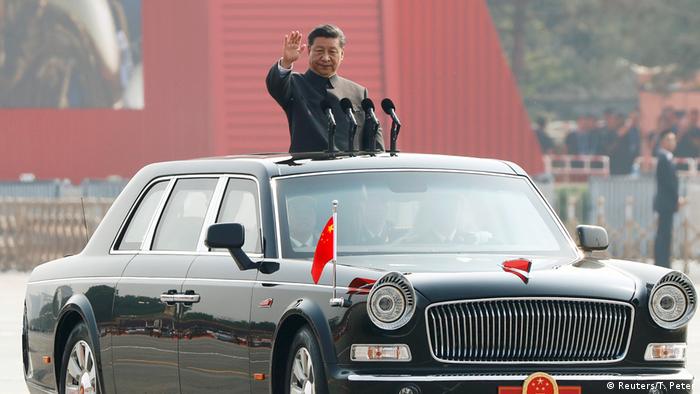
At the 19th convention of the Communist Party in October 2017, Chinese President Xi Jinping said that a "new era" had dawned for China and that the People's Republic was "getting closer to the center of the world every day." But how does China imagine a world order in which it is at the center-stage?
"My understanding is that the political forces in Beijing do not know exactly what they want. They're experimenting with Deng Xiaoping," Gu Xuewu, a Bonn-based political scientist, told DW, referring to the Chinese politician who initiated economic reforms in the 1980s. Deng's famous motto was "crossing the river by feeling the stones."
China's indecision is also reflected in complex debates about its role in the world, according to Volker Stanzel, a China expert and former German ambassador to Beijing. The debates deal as much with Beijing's acceptance of the prevailing global order as with the idea that China – chosen by fate – must lead the world.
As varied and complex these discussions appear to be, the Communist Party of China (CPC) has the final say in all matters, which are not necessarily about world order, according to Stanzel. "It is only a question about China being able to function in a way that the ideas of the CPC can be implemented, and which can help it stay in power."
Core elements of the 'Chinese world order'
Despite these ambiguities, Gu says that some key elements of the "Chinese order" can still be identified. "China wants a world order that is politically multipolar, functionally multilateral and ideologically pluralistic."
The expert explained China's ideals as follows:
Multipolar: A world dominated by several power centers – China, the US, Europe, Russia and maybe India.
Multilateral: A world in which no country alone determines the global agenda; it must be negotiated between all power centers.
Pluralistic: The world must accept different forms of governance and not just liberal democracy.
"We already live in a multipolar world," Gu said. Many political scientists agree that the short phase of American hegemony following the collapse of the Soviet Union no longer exists.
In China, multilateralism has been linked to Xi's catchphrase, "the community of common destiny." In 2019, Xi rejected isolationism and positioned China as a supporter of multilateralism in a speech at the World Economic Forum in Davos.
But Stanzel is skeptical.
"Common destiny is empty talk; it needs to be defined. How do you want to organize the world? With more international laws and stronger global institutions? But I don't think that either China or the US are interested in this," Stanzel said.
Both China and the US, however, give little value to international laws, said Gu. "They accept them only if they suit their own interests. They reject them if they conflict with their interests."
Beijing wants to improve its global image, with Confucius institutes promoting Chinese language and culture across the world. At the same time, Chinese investors are buying media companies in an attempt to alter China's global perception.
China is also actively participating in the United Nations. "China chairs four international institutions – twice as many as the US – and uses its position to include its political expression in UN documents," Stanzel said.
However, the success of Chinese measures is uneven in different parts of the world. "The narrative is successful in Africa, more so in states that are economically tied to China," Stanzel added.
In Germany and other industrialized countries, China's image has been dented due to its somewhat aggressive diplomacy. The detention and reeducation of hundreds of thousands of Uighurs in Xinjiang and the massive curbs on the freedom of Hong Kong citizens have further damaged China's reputation in Europe and the US.
The new Silk Road (Belt and Road Initiative, BRI), which was initially hailed as the world's largest infrastructure project, has also turned out to be a double-edged sword for many countries. Some critics say the project is making economically weak countries dependent on China. Sri Lanka, for instance, had to lease a deep seaport in Hambantota to a Chinese company for 99 years after failing to pay back loans.
Dominance in Asia
Gu believes that Chinese ambitions are significantly overestimated. "Anyone who wants to lead the world must be able to make general goods available free of charge and have a certain altruistic zeal to implement certain ideas globally," he said, adding that China lacks that. "China actually does not want to replace the US. It is even wary of taking on these tasks."
But even if China does not strive for global hegemony, its supreme status in Asia is beyond any doubt.
President Xi talked about "Asia for the Asians" in a 2014 speech. But what does the "Asia for the Asians" mean in the context of the Chinese order? A 2010 statement to the Association of the Southeast Nations (ASEAN) by then Chinese Foreign Minister Yang Jiechi can help us understand the dynamics: "China is a big country and other countries are small. It is simply a fact."
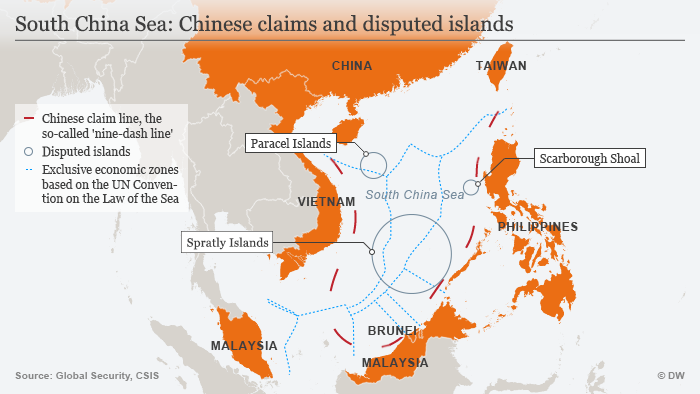
Nowhere in Asia is China's hegemonic claim more obvious than in the South China Sea. China is not only trying to force the US out of the region, it is also bringing key shipping routes and raw materials of the neighboring countries under its control. The consequences for "peripheral states" are instability and the growing pressure to choose between China and the US. There is also an increasing danger of an all-out military confrontation.
The Solomon Islands on Friday defended plans to sign a security deal with Beijing that could allow China to boost its military presence in the South Pacific island nation. A document, leaked on social media, revealed details of the pact, raising alarm bells in Australia, amid concerns China could try to establish a military base on the islands. The document says the Solomon Islands may "request China to send police, armed police, military personnel and other law enforcement and armed forces." It said Beijing could also send ships for stopovers and to replenish supplies. The draft also allows China to have the final say on any public information released about the new pact. The leak is believed to be part of wider security arrangements after the Solomons on Thursday agreed on a policing cooperation pact with China following anti-government protests in November that turned into riots. A Solomon Islands official told Reuters news agency that the agreement would be sent to the cabinet for consideration. Australia and New Zealand have for decades seen the Pacific islands as their "backyard" and any security pact with Beijing is a threat to their position in the region. Washington and Canberra have long been concerned about the potential for China to build a naval base in the South Pacific, allowing its navy to project power far beyond East Asia. Australian Prime Minister Scott Morrison said Australia and New Zealand were part of the "Pacific family" and had a history of providing security support and responding to crises. "There are others who may seek to pretend to influence and may seek to get some sort of hold in the region and we are very conscious of that," he told reporters. Former Australian Prime Minister Kevin Rudd told ABC Radio the proposed pact was "one of the most significant security developments that we have seen in decades and it's one that is adverse to Australia's national security interests." Australian Defense Minister Peter Dutton said any move to establish a Chinese military base in the Solomon Islands would be concerning. "We want peace and stability in the region. We don't want unsettling influences and we don't want pressure and coercion that we are seeing from China," Dutton told Channel Nine TV. New Zealand said Friday it would raise the issue with both the Solomon Islands and China. Chinese Foreign Ministry spokesman Wang Wenbin on Friday called on relevant parties to look at the security pact "objectively and calmly and not over-interpret it." About the security arrangement with Beijing, the Solomon Islands government said in a statement it was "diversifying the country's security partnership including with China." It added that "broadening partnerships is needed to improve the quality of lives of our people and address soft and hard security threats facing the country.” The government said the security arrangement with Australia, signed in 2017, would be unaffected.
Monday, July 4, 2022
HAPPY INDEPENDENCE DAY JULY 4,2022
The Founding Fathers of the United States were directed as well as inspired by God in the creation and writing of the United States Constitution. Over the 220 plus years that the constitution has existed the constitution has undergone many changes. To distinguish the original constitution from the constitution that the United States is governed by today we will call the original document the Founding Fathers Constitution. Yet the SCOTUS FAILED the interpretation of the original constitution by allowing party lines to influence their decisions.
"EQUAL JUSTICE UNDER LAW"-These words, written above the main entrance to the Supreme Court Building, express the ultimate responsibility of the Supreme Court of the United States. The Court is the highest tribunal in the Nation for all cases and controversies arising under the Constitution or the laws of the United States. As the final arbiter of the law, the Court is charged with ensuring the American people the promise of equal justice under law and, thereby, also functions as guardian and interpreter of the Constitution.
The Supreme Court is "distinctly American in concept and function," as Chief Justice Charles Evans Hughes observed. Few other courts in the world have the same authority of constitutional interpretation and none have exercised it for as long or with as much influence. A century and a half ago, the French political observer Alexis de Tocqueville noted the unique position of the Supreme Court in the history of nations and of jurisprudence. "The representative system of government has been adopted in several states of Europe," he remarked, "but I am unaware that any nation of the globe has hitherto organized a judicial power in the same manner as the Americans. . . . A more imposing judicial power was never constituted by any people."
The unique position of the Supreme Court stems, in large part, from the deep commitment of the American people to the Rule of Law and to constitutional government. The United States has demonstrated an unprecedented determination to preserve and protect its written Constitution, thereby providing the American "experiment in democracy" with the oldest written Constitution still in force.
The Constitution of the United States is a carefully balanced document. It is designed to provide for a national government sufficiently strong and flexible to meet the needs of the republic, yet sufficiently limited and just to protect the guaranteed rights of citizens; it permits a balance between society’s need for order and the individual’s right to freedom. To assure these ends, the Framers of the Constitution created three independent and coequal branches of government. That this Constitution has provided continuous democratic government through the periodic stresses of more than two centuries illustrates the genius of the American system of government.
The complex role of the Supreme Court in this system derives from its authority to invalidate legislation or executive actions which, in the Court’s considered judgment, conflict with the Constitution. This power of "judicial review" has given the Court a crucial responsibility in assuring individual rights, as well as in maintaining a "living Constitution" whose broad provisions are continually applied to complicated new situations.
While the function of judicial review is not explicitly provided in the Constitution, it had been anticipated before the adoption of that document. Prior to 1789, state courts had already overturned legislative acts which conflicted with state constitutions. Moreover, many of the Founding Fathers expected the Supreme Court to assume this role in regard to the Constitution; Alexander Hamilton and James Madison, for example, had underlined the importance of judicial review in the Federalist Papers, which urged adoption of the Constitution.
Hamilton had written that through the practice of judicial review the Court ensured that the will of the whole people, as expressed in their Constitution, would be supreme over the will of a legislature, whose statutes might express only the temporary will of part of the people. And Madison had written that constitutional interpretation must be left to the reasoned judgment of independent judges, rather than to the tumult and conflict of the political process. If every constitutional question were to be decided by public political bargaining, Madison argued, the Constitution would be reduced to a battleground of competing factions, political passion and partisan spirit.
Despite this background the Court’s power of judicial review was not confirmed until 1803, when it was invoked by Chief Justice John Marshall in Marbury v. Madison. In this decision, the Chief Justice asserted that the Supreme Court's responsibility to overturn unconstitutional legislation was a necessary consequence of its sworn duty to uphold the Constitution. That oath could not be fulfilled any other way. "It is emphatically the province of the judicial department to say what the law is," he declared.
In retrospect, it is evident that constitutional interpretation and application were made necessary by the very nature of the Constitution. The Founding Fathers had wisely worded that document in rather general terms leaving it open to future elaboration to meet changing conditions. As Chief Justice Marshall noted in McCulloch v. Maryland, a constitution that attempted to detail every aspect of its own application "would partake of the prolixity of a legal code, and could scarcely be embraced by the human mind. . . . Its nature, therefore, requires that only its great outlines should be marked, its important objects designated, and the minor ingredients which compose those objects be deduced from the nature of the objects themselves."
The Constitution limits the Court to dealing with "Cases" and "Controversies." John Jay, the first Chief Justice, clarified this restraint early in the Court’s history by declining to advise President George Washington on the constitutional implications of a proposed foreign policy decision. The Court does not give advisory opinions; rather, its function is limited only to deciding specific cases.
The Justices must exercise considerable discretion in deciding which cases to hear, since approximately 7,000-8,000 civil and criminal cases are filed in the Supreme Court each year from the various state and federal courts. The Supreme Court also has "original jurisdiction" in a very small number of cases arising out of disputes between States or between a State and the Federal Government.
When the Supreme Court rules on a constitutional issue, that judgment is virtually final; its decisions can be altered only by the rarely used procedure of constitutional amendment or by a new ruling of the Court. However, when the Court interprets a statute, new legislative action can be taken.
Chief Justice Marshall expressed the challenge which the Supreme Court faces in maintaining free government by noting: "We must never forget that it is a constitution we are expounding . . . intended to endure for ages to come, and consequently, to be adapted to the various crises of human affairs."
The U. S. Founding Fathers were provided with a unique perspective that few people in history have experienced firsthand that is living under both extremes of government rule. The authority of a tyrannical government as well as living under an ineffectual government charter with insufficient powers to govern. Initially life under the King George III of England was acceptable. In fact, most of the people enjoyed life under the authority of the King of England. As time passed grievances arose that the King was unable or unwilling to address. The King’s unwillingness to correct the problems encountered by the colonists mounted till corrections had to be made. The King refusing to address the problems worsened the situation for the colonists by adding additional laws, tariffs and taxes onto the backs of the colonists. A once loved King George III became a tyrannical leader. The U. S. Founding Fathers attempted to redress the situation through every legal avenue they had available. This eventually led to a hardening of positions on both sides which in turn led to the Revolutionary War.
Life under an Ineffective Government Charter
The colonies after cutting ties with England established a charter the Articles of Confederation to administer the duties, obligations of the thirteen colonies as well as conducting the war. The Articles of Confederation were found to be ineffective not providing sufficient authority to the central government. The Articles of Confederation were dependent upon the colonies relinquishing authority over their territory. The colonists as well as their colonial governments were unwilling to give the central government sufficient authority to effectively govern the thirteen colonies. In spite of these deficiencies the Colonists were able to win the Revolutionary War. George Washington credited the colonies performance in the war to acts of Providence. The colonists lived several years under the limited authority of the central government governing using the Articles of Confederation charter. This allowed the colonists to understand the disadvantages of life under a government that did not possess sufficient authority to effectively rule. Living under these two extremes the Founding Fathers knew the disadvantages of both governmental entities. The Founding Fathers historical experience allowed them to create a comprehensive document designed to protect the rights of the people.
The Founding Father’s Constitution
Life under the rule of the King taught the colonists to fear absolute control. Whereas life under the charter of the Articles of Confederation taught the Founders that a central government must have certain powers and authority to be able to govern properly. Faced with these two opposing positions the U. S. Founding Fathers undertook the creation of the United States Constitution.
Checks and Balances
The Founders were fearful that a central government over time would increase its authority and control over the people established sets of checks and balances to limit the ability of the central government to morph into a tyrannical government without the approval of the States and the people. To protect the rights and freedom of the people checks and balances were established. Thomas Jefferson believed that the government at the State level, being closer to the people, would provide the people with greater representation. By balancing the authority of the national government with the combined powers of the States the powers of the national government are limited. In this manner the powers of the Federal government are balanced between the States and the Federal or central government. Though the power of the Federal government was now balanced the Founding Fathers were still fearful that the central government could still develop into a tyrannical government body. Further checks were established to limit and restrict the ability of the central government from acquiring additional authority and power over the people. Among the checks three entities of the national government established branches with specific duties and responsibilities. Each branch had VETO authority over the other branches. The bi-camel congress was given separate distinct responsibilities. A bi-camel congress was established to represent their segment of the controlling government bodies. The Senate was to defend the State’s rights whereas the House of Representatives were to represent the people. It is this VETO authority that provides the checks to an out-of-control Federal government.
States Rights
The Federal government’s authority and powers are derived directly from the States. The States were placed between the Federal government and the people. In this way the States are a “Wall of Political Protection” protecting the rights and freedom of the people. To accomplish this control authority the States were provided with Senators that would be under direct control of their State legislature. The U. S. Senators were to report directly to their State legislature to determine the response the Senators should or should not take at the Federal level of government. The U. S. Senators were appointed by their States legislature. The Senators were subject to the dictates of their particular State’s legislature. In this way the States could protect the States authority as well as protect the freedom of its citizenry from infringing power of the Federal government. The House of Representatives was established to represent and protect the people of their state. The House Representatives were elected by their state’s registered voters. The House Representatives served subject to the dictates of the people.
Founding Fathers
The Founding Fathers established the separation of powers along with the redundancy of checks and balances so that the unalienable rights and freedom of the people could be adequately protected. The Founders were so fearful of the possibility that the central government would morph over time to become tyrannical that the Bill of Rights was added to the Founding Fathers constitution. The Bill of Rights established the specific restrictions dictating the limits that were to be placed on the Federal government. It was only with the addition of the Bill of Rights to the constitution that all the Founders got on board willing to accept the Founding Fathers constitution as the official governing document. The Founders constitution was completed in 1787 and enacted in into the law of the land in 1789.